



Today we’d like to introduce you to David Bernhardt.
Hi David, can you start by introducing yourself? We’d love to learn more about how you got to where you are today.
I got my start in digital art when I was making canoeing GoPro videos at 15. I wanted a way to show friends and family what it was that my dad and I did for fun because sometimes it can be hard to explain the specific formations on rivers we were talking about. The process of learning was always one of finding a new problem to hit my head against and finding the solution to it. My first edit was footage from a canoe race I was in on the Tellico river. There were probably close to 100 canoes on the river that day. So the entire video, I was just getting bumped into or dodging people while trying to navigate going down waterfalls. The whole event is nothing but chaos.
Later on, The next year, I took a web design class in high school. This is my first time working with 2D visuals like banners and logos. I quickly realized that I was not good at the coding aspect of the web design class. But I could compose an appealing layout and make good graphics often better than some of my peers. I didn’t find out until I was 21, but this is because I’m dyslexic. I always struggled to find errors in my syntax, and it was often because of a semicolon or something else small out of place that I wasn’t well equipped to find. Luckily the solution to this problem kind of just chose me. My friend Tyler Greene helped me with almost all of my assignments in that class. He would do the technical part, like the coding and the bare bones of the UI design, and I would work on the color palette and make the graphics. Part of me always felt bad about doing things that way, so I would always try and push the boundaries of what I knew how to do with my graphics. The desire to push myself has always been a huge motivational factor in my creative work. I always try to attain a new level of detail, mix up the style, or try a new subject matter to do something new where I must improve. The pursuit of improvement has always been one of the largest motivating factors behind my artwork. I feel like if I don’t try to push myself to improve, I will hate whatever it is that I have created.
It would be fair to say that I didn’t start to try to push the art aspect of my designs until I got to college. In college, I kept experimenting with Photoshop and making videos, but I tried to add more of myself to what I was making this time. I started making kind of state-of-mind pieces out of self-portraits. So an example of one of these would be an old work called Dread, Where I was feeling very depressed and isolated at the time. So, I used a photo of myself and photos of the room I was home-schooled in as a kid to portray my current dread at its source.
Home school for me was hell. Every day it was something new that I was doing wrong or I “wasn’t trying hard enough” somewhere else. In reality, all of my issues stemmed from my dyslexia and ADHD. I didn’t know that I had dyslexia until I was 21, and I didn’t know I had ADHD until I was 23. For a long stretch of my formative years, I blamed myself for shortfallings that were entirely consequences of my birth. I always wondered as a kid why it took me longer to do my schoolwork than my sister or why none of my friends mentioned having similar problems at school. Once I found out as an adult, many things made much more sense to me. And I was immediately met with mockery and treated like a child again. People are asking me if they need to read a note to me that they’ve written people asking me to put into detail what dyslexia is like. As if any respect for me had gone out the window.
In college, I worked for several offices at Tennessee tech university where I did video editing and some graphic work. I’ve worked for TTU iCube, Where I helped do color corrections on videos, learned about 3D modeling, and led tours of the facility showing school groups the VR demonstrations/games they developed there. I also helped put together a grant video for the office of rural innovation for a program that put together nursing and engineering students to find problems they could solve within a hospital setting. I then went on to edit videos and photos for ATC automation for marketing material and record-keeping purposes. In my junior year of college, I returned to TTU to work as the video editor for the development office. While there, I recorded and edited footage from their annual women’s conference And helped make grant application videos. And then COVID hit. The office of development lost funding for my position and I had to start taking service jobs. From there, my work started to be a little more self-reflective.
Would you say it’s been a smooth road, and if not, what are some of the biggest challenges you’ve faced along the way?
It hasn’t always been an easy road. I would often get in trouble in high school because my parents would think I was dodging homework to make videos and photoshop projects. I always had a strict mental inventory of my homework to finish it. Even longer was the list of excuses for when saying I’ve finished all my homework wasn’t good enough. My mom wouldn’t even let me take traditional art classes in high school because she thought there was a chance I could fail those classes. My parents always outwardly looked down upon artists. There was never a reference made to an active artist without outward disdain following mentioning them. There is no winning being raised by two parents with a master’s in accounting. You either lose now or later. I doubt my family will ever have faith in the value of my creative work.
Alright, so let’s switch gears a bit and talk business. What should we know about your work?
I have always tried to be a jack of all trades. I have wanted to invest my energy into becoming as flexible in the digital realm as possible. I always want to consider what medium will most successfully convey the desired story or theme at hand if I am making something about a process like my creative process—the story of how something comes together. Or, if movement is the central theme that I want to convey to the viewer, I use a video format. I have been thinking a lot if I want to provide a glimpse into my state of mind or something. I will use an illustrated format. Drawing the feelings into the scene, trying to convey them so that the viewer can understand the experience behind the image if they care enough to. I use photography to showcase my surroundings if I try to show something I see and convey my point of view. Often I will also use photo manipulation to experiment as well. Whether I am cloning myself within a scene, mixing photography and illustration, or completely fabricating a scene.
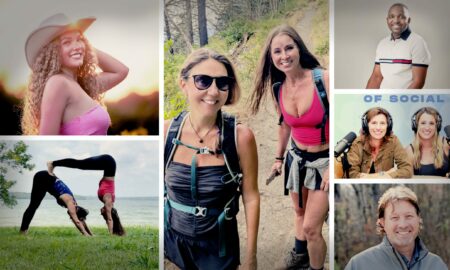
All of these components are what come together to form me as an artist. Great examples of all these components are the fake interview magazine I made for my intro to design class I made my senior year of college. A piece I called “All I Feel” is a much more personal example of how my style works. I made “All I Feel” while working the night shift at an Academy warehouse. While working there, I was struggling with the lifestyle associated with working the night shift. I was waking up at 1 PM, eating one huge meal, and going to work at 4:45. Academy then made us wait until 4:53 to clock in for our 10-hour shift. All I did for 4 months was work and sleep. I felt so stuck. The moments between shifts felt like waiting for the other boot to drop. I was waiting to go back to that maze of blue and yellow shelves to do pointless tasks moving boxes from one end of the facility to the other. I only made this piece because I found a note on the ground of the warehouse that said “fixed’ I copied the handwriting for the note on the box on the right side of the image.
Do you have any advice for those just starting?
I would advise any new artist to experiment at every opportunity. Always be open to new experiences and challenges. Try new methods. Every time I finish a project, I take notes of what to do differently for the next project. Even though I use 3 main mediums, they are all related to the heavy use of technology. My toolset is the skeleton of my style. The meat of it all comes together when I figure out what I want to convey to the viewer. Find a way to convey your stories and ideas that are fulfilling for you. Don’t worry about what is popular or what gets people’s attention. Make things that you can be proud of. Find community! My family never fully supported my creative ambitions past the occasional throwaway comment, especially not in the beginning. Now between my friends in the gaming community I run and in person, I have a great network of support. Friends of mine have modeled for me and helped me take reference photos. It is helpful to have people around you who support you in your creative ventures.
Contact Info:
- Website: https://www.dbernhardtportfolio.com/
- Instagram: https://www.instagram.com/canoesgallery/
- Twitter: https://twitter.com/imthecanoe
- Youtube: https://www.youtube.com/channel/UCRFmoMPF3C-t3dzxRtBPMkQ


Image Credits
I created all of the assets used for my images