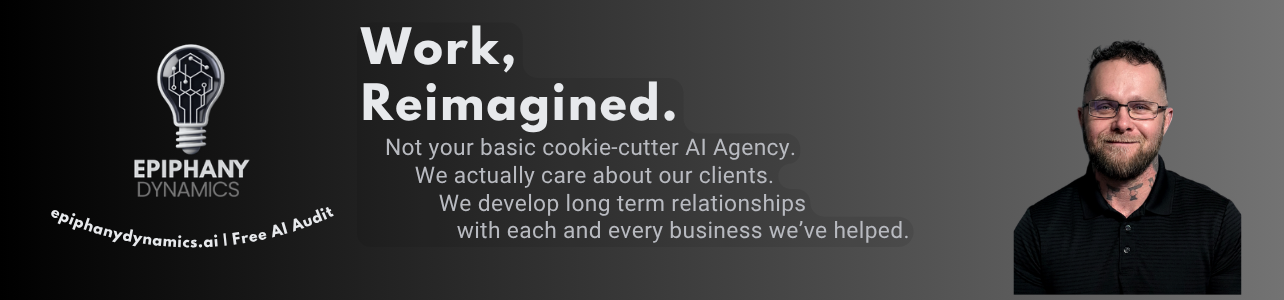






Today we’d like to introduce you to Patrick Gibbs.
Hi Patrick, thanks for joining us today. We’d love for you to start by introducing yourself.
I grew up in a small town in Tennessee. Blue-collar father, a diesel mechanic. My mother had her own struggles with addiction. They divorced when I was ten. By twelve I was already in and out of juvenile detention. By 23 I was sitting in federal prison on a conspiracy charge for distributing over a kilo of heroin. Got out, relapsed on pain pills, ended up in Florida and did another stint. Twenty-seven months in county jail and five years in state prison. Eight years total inside, across two stints.
I got sober in late 2013, which means I served most of my time clean. Going on 12 years sober now.
Released from Florida state prison on November 2, 2020. Came straight home to Tennessee and went into the trades. Took a job inspecting sewer pipes. Twelve-hour shifts, hands-on work, the kind of job most people don’t want. I climbed in that company faster than I expected, got my income up to just over six figures, and for the first time in my adult life started taking care of my health, my fitness, and my financial discipline.
About a year ago I realized that as good as the trade was to me, I didn’t want to spend the rest of my life inspecting pipes. I tried a handful of small businesses. None of them landed. Then I started using AI and automation tools for my own personal projects and quietly realized that what I was doing for fun was actually the business.
I founded Epiphany Dynamics on December 22, 2025. We’re an AI automation agency. We build the systems small and mid-sized businesses are still doing manually. Voice agents, lead pipelines, custom workflows, whatever the operational pain is. The agency is four months old and earning real revenue.
The pitch I’d give to anyone who reads this and thinks they’re stuck: the tools available to a one-person business in 2026 are unrecognizable from what existed five years ago. You don’t need a team, you don’t need outside funding, you don’t need a clean track record. You need a real problem to solve and the discipline to keep showing up. Both of those, prison teaches you for free.
Would you say it’s been a smooth road, and if not what are some of the biggest challenges you’ve faced along the way?
The road has been anything but smooth.
The first obstacle was funding. I bootstrapped this entire thing. No investors, no savings buffer, no co-founder splitting the load. Every dollar Epiphany Dynamics has spent on tools, infrastructure, certifications, and marketing came out of my own pocket. That constraint forces real discipline. It also means I move slower than I want to.
The second was pricing. When you sell AI automation to small business owners, you are selling something most of them have never bought before. There is no reference price. They have heard “ChatGPT is free” and they have heard “an enterprise AI platform is a quarter million a year” and they have no idea where a real custom build for their business sits between those two numbers. I spent more hours in my first months on pricing strategy and explaining value than on actually building product. I had to learn to stop quoting hourly and start quoting fixed-price outcomes with milestones. The moment I made that switch, things started moving.
The third was failure. Before Epiphany Dynamics worked, I tried several other small businesses that didn’t. I won’t name them because they don’t matter, but each one taught me what doesn’t work. Most founders I see online want to skip the failure step. You can’t. The failures are how you find out what fits.
The fourth was time. Running a one-person agency means every hour you spend on one thing is an hour you can’t spend on the other ten things on the list. Sales eats build time. Build time eats marketing time. Marketing time eats client delivery. There is no clever way to make this stop. You triage, you ship, you take the hit on the things you couldn’t get to, and you start the next day.
The fifth, honestly, was self-trust. Coming out of prison and getting sober rewires what you believe you are capable of. Choosing to bet on yourself again, after a long stretch of being told who and what you were by other people, is a harder lift than any technical work the agency requires. There is a voice in your head that tells you to stay small, stay quiet, don’t draw attention. That voice is wrong, but it is loud. Building anything new requires learning to keep moving forward while it is screaming.
The struggles were real. They still are. But none of them are unique. Every founder has a version of this list. The question is whether you keep going.
Thanks – so what else should our readers know about Epiphany Dynamics LLC?
Epiphany Dynamics is an AI automation agency. We build the systems small and mid-sized businesses are still doing manually. Voice agents, AI receptionists, lead pipelines, automated client onboarding, internal workflows that replace stacks of SaaS subscriptions, and custom integrations that connect tools that were never supposed to talk to each other. We are based in Tennessee, but we work remote-first with clients across the country and internationally.
We don’t sell a fixed product menu. We sell diagnosis first. Most agencies show up with a hammer and look for nails. We start every engagement by auditing the actual operational pain points in the business, then we recommend whatever fixes them. Sometimes that’s an AI voice receptionist. Sometimes it’s a custom workflow runtime. Sometimes it’s a complete teardown and rebuild of how a sales pipeline routes inbound leads. We will not pitch you a build you don’t need to make a sale.
What sets us apart is operator perspective. I came up running operations and working with my hands, not out of an AI research lab. Most of our clients are not engineers. They are owners running active businesses who don’t have time to learn the difference between a vector database and a fine-tuned model, and they shouldn’t have to. We translate. We own the technical complexity so the owner can keep running their business while the systems we build run quietly in the background.
The verticals we serve are intentionally varied. Med spas, dental practices, mortgage brokers, e-commerce brands, home services, professional services, and several others. The technology stack is largely the same across them. The pain points are different. Working across verticals means I see patterns that single-vertical agencies miss.
I am most proud of two things. First, the work we ship for clients actually runs in production and earns them real money. We have shipped voice receptionists that handle live customer calls, payment integrations that process real transactions, and workflow systems that have eliminated hours of manual work per week. Nothing we have built is a demo. Second, we ship a free educational platform called Epiphany Learn at epiphany.help. Seven modules that teach business owners and operators how to think about AI, what’s worth automating, and what isn’t. No paywall, no signup gate. The learning is free because too much of the AI industry profits from confusion.
For any up-and-coming entrepreneur reading this: the biggest unlock available to you in 2026 is leverage. AI tooling that did not exist five years ago now lets a one-person business operate at the scale of a five-person team without the payroll. You don’t need a co-founder, an outside investor, or permission from anyone. You need a real problem to solve, the willingness to ship before you feel ready, and the discipline to keep learning what’s actually working under the hype. Spend less time picking the perfect tech stack and more time talking to the people who would pay you to fix something. The market answers the question “is this real” faster than any business plan ever will.
What I want readers to know: AI automation is not magic, and it is not generic. The right build for your business depends on what your business actually does. If you want to talk through what’s possible for your specific operation, that conversation is free. The work after that is fixed-price, milestone-based, and has receipts.
Before we let you go, we’ve got to ask if you have any advice for those who are just starting out?
Hard work, determination, and consistency. That’s it. That’s the whole answer. Everything else is detail.
I’m not saying that to sound tough. I’m saying it because I’ve watched people with better resumes, better connections, and better starting points get out-run by people who simply refused to stop. Every time. The talent gap matters less than the consistency gap. The consistency gap is everything.
Show up every day. Even the days you don’t feel like it. Especially those. Motivation is unreliable. Discipline is what carries you through the months where nothing seems to be moving. The founders who make it aren’t the ones who felt motivated every day. They’re the ones who kept showing up when the feeling was gone.
That said, hard work in the wrong direction is just exhausting. So here are three specific things I learned the hard way that will save you time:
Stop quoting hourly. Customers don’t care how many hours something takes you. They care what it does for them. Quote the outcome, charge a fixed price for it, and let your speed work for you instead of against you. The day I made that switch was the day Epiphany Dynamics started actually closing deals.
Fail faster than your pride wants you to. Before this business, I tried several others. Each one took me longer to walk away from than it should have because I had told everyone I was doing it. Pride keeps you in dead businesses. Treat your first attempts as cheap experiments, not life commitments.
Talk to fifty potential customers before you build anything. Not five. Fifty. The first ten will tell you what you want to hear. The next twenty will tell you what they think they want, which is usually wrong. The last twenty will start telling you what they actually need and would pay for. That’s the data you build off. Most founders skip this step because it’s uncomfortable. The discomfort is the work.
The thing I wish I had understood from day one is that you can’t out-hustle bad positioning. You can grind for a year on a message that doesn’t land and you will still be exactly where you started. So work hard. Stay consistent. But check the direction often. Hard work plus the wrong direction is a slower path to the same nowhere.
The only person you have to beat is yesterday’s version of yourself. Beat that one every day and the rest sorts itself out over time.
Contact Info:
- Website: https://epiphanydynamics.ai
- Instagram: https://www.instagram.com/epiphanydynamics
- Facebook: https://www.facebook.com/patrick.gibbs.31149 and https://www.facebook.com/epiphanydynamics/
- LinkedIn: https://www.linkedin.com/in/patrick-gibbs-839b7b237
- Twitter: https://x.com/EpiphanyDynamic
- Other: https://epiphany.help