



Today we’d like to introduce you to Christian Grosselfinger.
Christian, we appreciate you taking the time to share your story with us today. Where does your story begin?
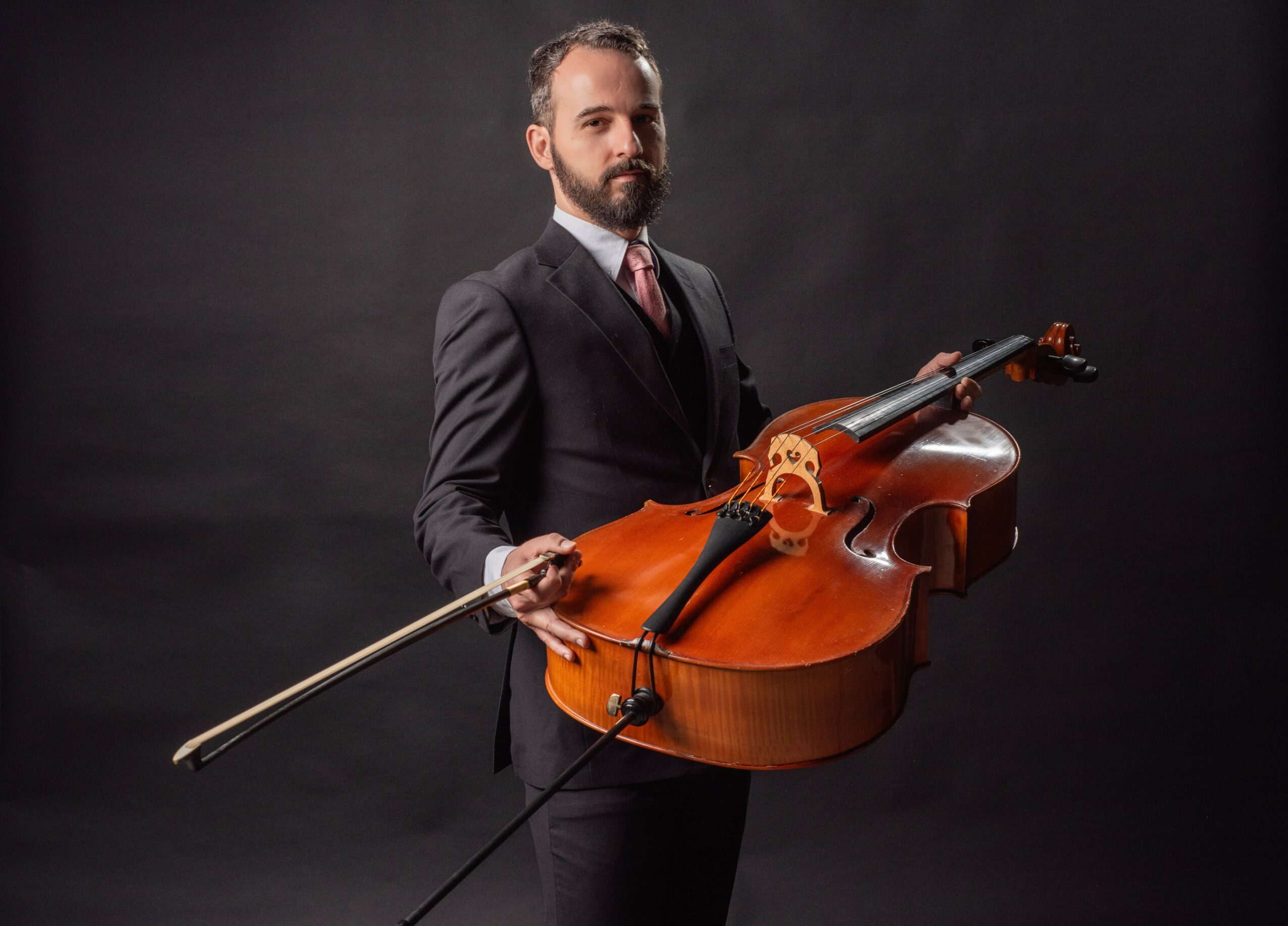
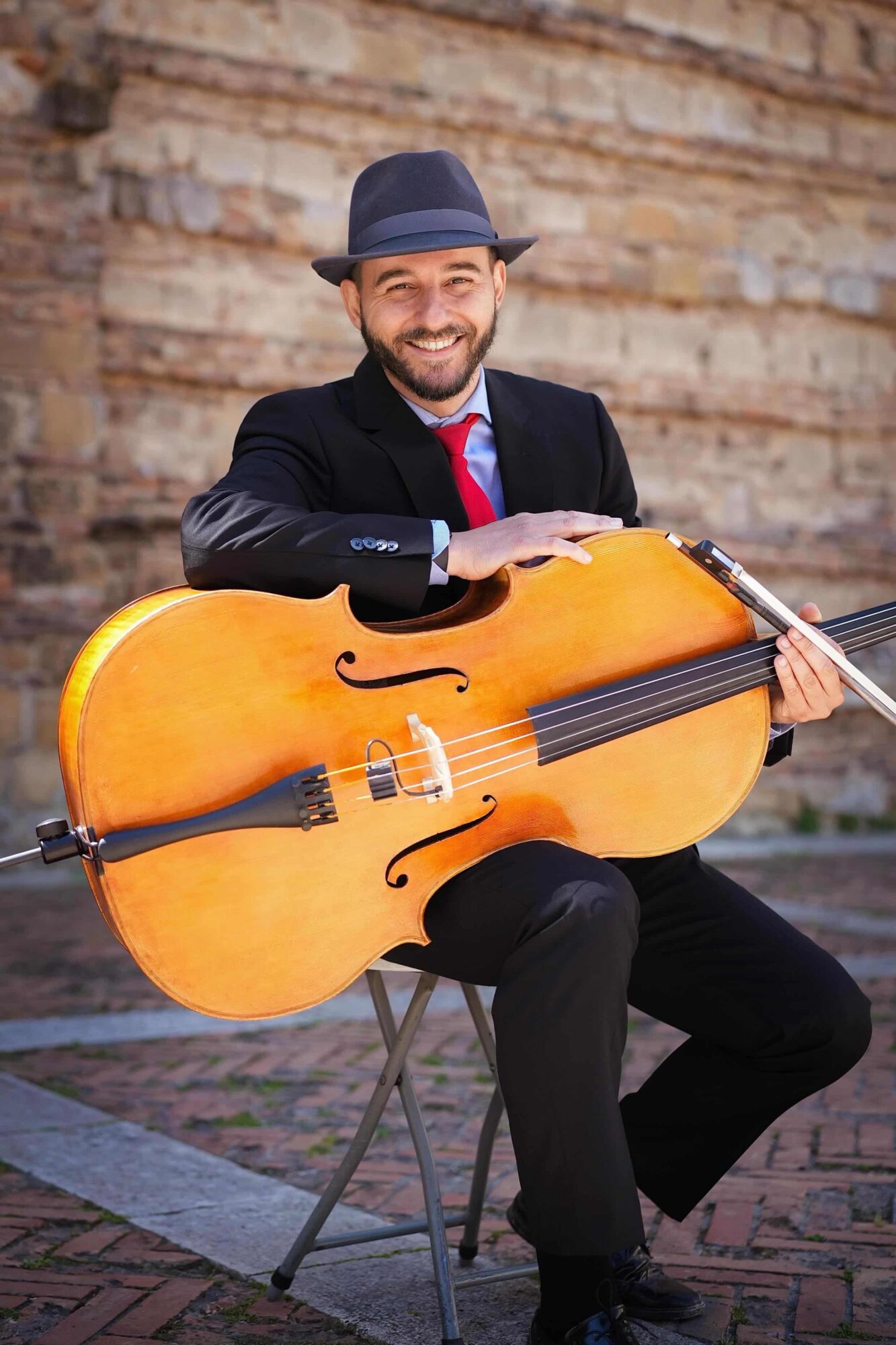
I’m Brazilian, from Guaratinguetá — a small city in the interior of São Paulo state. I studied Composition at UNIRIO in Rio de Janeiro, and I came to the cello for a completely unromantic reason: I’d been playing guitar for years and had never earned a single cent from it. The cello was the one instrument that could actually pay — weddings, events, orchestras. I learned it to survive. I fell in love with it afterwards, and I’ve never stopped.
I won a scholarship to study in Europe and moved to Portugal to take private lessons with Paulo Gaio Lima. The scholarship covered the lessons but not the living, so I started playing on the streets of Lisbon to make up the difference. I was earning about twelve euros a day and I was genuinely happy with it.
Then, in Vienna, I met a street musician named Roxana — someone I now think of as a sister. She was living entirely from her art, paying all her bills, even taking holidays, and I couldn’t understand how. I asked if I could play alongside her once just to watch how she did it. Afterwards I asked what she thought of my playing and she said, “I’ve seen worse. I think you have potential.”
Then she gave me three pieces of advice. Wear the best suit you own. Play it like a concert, never like a practice session. And keep the space around you clean, so people see only you and the instrument. I did exactly that the next day and went from twelve euros to sixty. That was 2011, and that was the day I understood I could build a life out of this.
For years after that I lived and worked out of a motorhome, playing the streets of Florence, Lucca and Siena six to eight months a year, touring, and going home to Brazil to be with my son whenever the money allowed.
Then in March 2020 I drove up into the Apennines for a few days of skiing and woke up to every ski lift on the mountain stopped. Italy had gone into lockdown overnight. Everyone packed up and went home, and within hours I was the only person left in that car park — because I had nowhere to go home to. I thought it would be two weeks. I was there for six months.
It was the hardest period of my life, and it’s also the reason my career looks the way it does now. I composed every single morning in that vehicle and came out of it with the material for two albums. And in the afternoons, with nothing else to do, I taught myself to code. At the time it just felt like a way to keep my mind alive.
Six years later, both of those things are my job. The music from that mountain is on stage, and the code became a system I built myself that researches venues, writes to each one in its own language, and manages a three-month tour — which is how I book over a hundred concerts a year with no agency behind me.
Today I perform three shows of my own: Cello Storm, which fuses rock and metal with classical — AC/DC and Muse alongside Ravel’s Boléro and my own compositions; Epic Scores Live, a journey through film and video-game scores; and Romantic Cello, the intimate one. All three are one person on stage, using live looping to build a full band in real time.
In 2026 I played 36 concerts across Europe. In January I set off again — three months, Salzburg to Lisbon, still in a motorhome. Still doing it myself.
Would you say it’s been a smooth road, and if not what are some of the biggest challenges you’ve faced along the way?
No, it hasn’t. And the strange thing is that the hardest parts were never about the music.
The worst of it started in March 2020. I’d driven up into the Apennines for a few days of skiing, and I woke up one morning to the sound of dozens of people talking at once. I looked up at the mountain and every ski lift was stopped. I had never seen that in my life. Italy had gone into lockdown overnight, and everyone was told to go home.
Within a few hours I watched that whole car park empty out, one vehicle at a time, until I was the only one left — because I didn’t have a home to go to. Home was Brazil, or Portugal, or the motorhome I was standing next to. I thought I’d be there two weeks. I was there six months.
I was lucky in one way: that car park had an electricity and water cabin, and that genuinely saved my life, because it dropped to eleven below at night. But the bathroom floor in the vehicle was broken, so I couldn’t use the shower. I washed in the river of snowmelt instead. It felt like knives going into my skin.
Then the money ran out. I’d been sending everything I had to Brazil for my son, and there was nothing coming in — I couldn’t work, and nobody was hiring an online music teacher they’d never heard of. I looked into hunting and gave up on it, partly because I was hopeless at it and partly because I’m vegetarian. A woman at one of the closed hotels saw me walking around and gave me a box of food that would otherwise have spoiled. A man who drove the snow plow brought me groceries, and when I asked how much I owed him he shouted “ah, go take a crap!” out of the car window and drove away. That’s Tuscany — they shout at you first and help you immediately afterwards.
Eventually the police started coming by. I assumed I was in trouble, but they had me legally register that car park as my official address, and after that they’d stop in twice a week just to check I was still alive. When I told them I had a week of food left, they were the ones who arranged for the Red Cross to start bringing me a parcel every Saturday.
I felt humiliated at first. I’d seen those donation trolleys in supermarkets my whole life and never once pictured a real person at the other end of them. That month, the real person was me. Now I think it’s one of the most important things that ever happened to me — it taught me that sometimes people genuinely cannot manage alone no matter how hard they try, and I’ve never assumed otherwise about anybody since. As soon as I was earning again I started giving back to them.
There were smaller disasters throughout. My bike brakes exploded halfway down a mountain descent with all my shopping strapped to it, and the only thing that saved me was a reflex from childhood — throwing the bike into the tightest turns I could to kill the speed. One spring the wind was so violent for a week that I couldn’t sleep at all, convinced the vehicle was going to be blown over.
The lowest point was the day I finally got a flight home to my son. I got the road cleared of snow, drove down, took the bus and the train, walked up to Florence airport — and found police tape across the entrance. The entire airport was closed. I stood there for a long time unable to speak. That night I drove back up the mountain in a blizzard and both my snow chains snapped. I ended up digging out the last stretch by hand with a borrowed shovel.
Even the recovery was slow. The first day it was legal to work again, I drove to Lucca — a city that is normally full of people — and played for three hours in an almost empty street. I earned enough for one slice of pizza.
Honestly, the day-to-day struggle now is a quieter version of the same thing. As an independent artist you’re also your own booking agent, your own manager, your own marketing department. I write to venues in German, French, Dutch and Swedish — languages I don’t always speak — because I’d rather reach someone properly in their own language than be one more anonymous English email. Most of them never reply.
But I’ve never seriously thought about stopping. Every “no” narrows the search, and every “yes” is a night that only exists because I kept going. After that mountain, that trade seems very fair to me.
As you know, we’re big fans of you and your work. For our readers who might not be as familiar what can you tell them about what you do?
I’m a cellist and composer, and what I actually do is build entire concerts out of one person.
On stage it’s cello, electric guitar and keys, and I use live looping to construct everything in real time — I lay down a bass line with the cello, add a riff, add a rhythm, and then play over the top of what I’ve just built. There’s no band behind me and no pre-recorded tracks pretending to be one. The audience watches the whole thing get assembled in front of them, and there’s a moment in every single show where people work out what’s happening and their faces change. That moment is the reason I do this.
I have three shows, and I keep them separate on purpose, because a rock club and a thousand-year-old chapel are not the same room and shouldn’t get the same concert. Cello Storm is the loud one — a fusion of rock, metal, pop and classical, where AC/DC and Muse sit next to Ravel’s Boléro and my own compositions. Epic Scores Live is a cinematic journey through film and video-game scores — Interstellar, Wonder Woman, Zelda. Romantic Cello is the intimate one: the songs people already carry in their hearts, played close and quiet.
What I’m proudest of isn’t a venue or a review. It’s two albums I wrote alone in a motorhome on a mountain during the 2020 lockdown, with no money, no plan and no idea when it would end. I composed every morning for six months. That music is still what I play, and every time I perform it, it means something to me that nobody in the audience can see.
The second thing I’m proud of is less romantic but I think it matters more. During that same period, with nothing else to do, I taught myself to code. Six years later I’ve built my own system that researches venues across Europe, writes to each one in its own language, and manages every conversation across a three-month tour. That’s how I book over a hundred concerts a year with no agency, no manager and no label behind me. Most independent musicians I know are waiting for someone to open a door. I got tired of waiting and built the door.
As for what sets me apart — I think it’s that I learned this job on the street.
For years I made my living playing on the streets of Lisbon, Florence, Lucca and Siena. Street audiences owe you absolutely nothing. Nobody bought a ticket, nobody sat down, nobody agreed in advance to care. If you don’t earn their attention in the first fifteen seconds, they keep walking — and you can watch them do it. That’s a brutal education, and it never leaves you. When I walk onto a proper stage now, I’m not assuming the room is mine. I’m still earning it from the first note, and I think people feel that.
It also means I’m genuinely at home in wildly different rooms. In a single tour I’ll go from a pub in Brighton to a chapel in France to a theatre in Germany, and none of that intimidates me, because I’ve already played to people who were on their way to buy bread.
I still travel by motorhome — the cello, the gear and I all fit — and I still book every date myself. It’s not the most efficient way to have a career. But it means the whole thing is mine, and after everything it took to get here, that matters to me more than comfort does.
We’d be interested to hear your thoughts on luck and what role, if any, you feel it’s played for you?
I think luck is completely real. I just think it almost never looks like luck at the time — in my experience it usually arrives as another person deciding to be kind.
I’ve had plenty of the bad kind. A global pandemic that stranded me alone on a mountain for six months. An airport that turned out to be closed after I’d spent a week arranging the trip home to my son. An airline that went bankrupt with my ticket in it. Both snow chains snapping on a blizzard road at night. Bicycle brakes exploding halfway down a descent. You can’t plan for any of that.
But the good luck in that same period was almost absurd.
A few days before everything shut down, I stopped at a supermarket on my way up the mountain. I always shopped for three or four days at a time — that’s all I needed, and I had no working fridge. For no reason I’ve ever been able to explain, that day I bought eleven days of food. I remember standing there thinking, I never buy this much. I bought it anyway. Less than a week later the country was locked down and I couldn’t leave the car park.
The place I happened to be parked had an electricity and water cabin — which is the only reason I survived nights at eleven below. A restaurant in the village closed down and left its wifi modem switched on, so once a day I could walk over with my laptop and download enough work to keep going. None of that was planning. That was just where I happened to be standing when the world stopped.
But the moment that changed how I think about luck was the day of the closed airport.
Driving back up the mountain that night, the police pulled me over and wrote me three fines. The biggest was five hundred euros for being on the road without a valid reason. I explained everything — the ticket, the airport, that I had to get back to the only place with water and electricity. It made no difference. I asked them, honestly, what they would have done in my position. One officer looked at the other and said, “Exactly what you’re doing.” And then wrote the fine anyway.
He handed it over and asked me to check the details. I read down it, and where it said address, he had written one word: Brazil. Then he looked up at me, smiled, turned around and walked away. He was under orders to write that fine. He made absolutely sure it would never reach me.
I’ve never forgotten it. It was the first time in months I felt like a human being instead of a problem.
Even the business side has worked like that. A grant that partly funded one of my recordings came through because my stepfather asked if he could enter me for it, and I said yes without paying attention and forgot about it entirely. Months later he told me I’d won.
So — yes, luck matters enormously, and I don’t pretend I earned all of it. But I notice it only ever found me while I was still out there. Nobody hands you a food box, or plows your road, or quietly protects you from a fine you can’t pay, if you’ve already gone home.
Contact Info:
- Website: https://www.christiangrosselfinger.com
- Instagram: https://instagram.com/iamchrisgrosselfinger
- Facebook: https://m.facebook.com/christiangrosselfinger
- LinkedIn: https://www.linkedin.com/in/christian-grosselfinger-664537174
- Youtube: https://www.youtube.com/c/ChristianGrosselfinger