




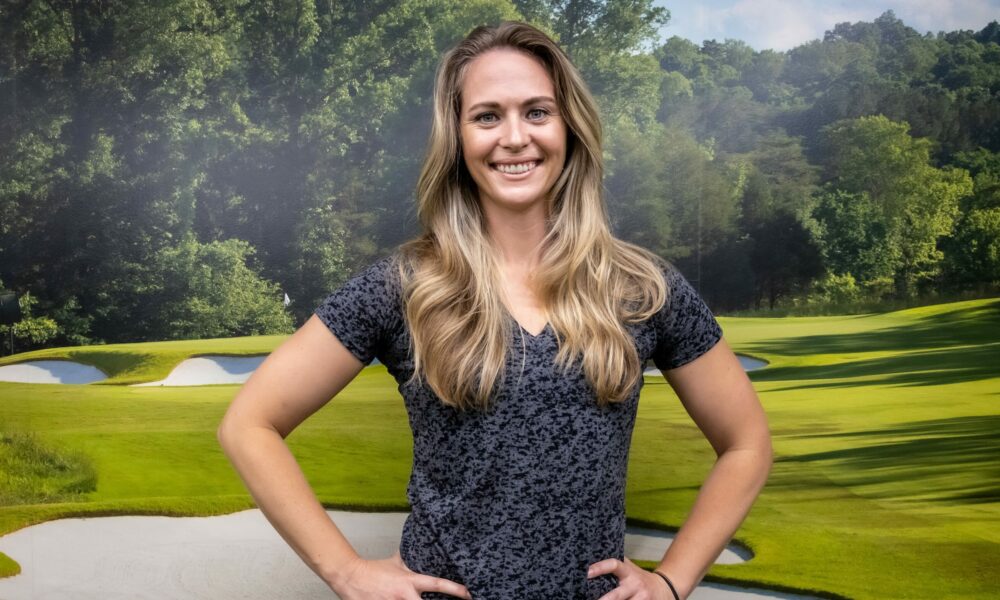
Today we’d like to introduce you to Jillian Keeler.
Hi Jillian, it’s an honor to have you on the platform. Thanks for taking the time to share your story with us – to start maybe you can share some of your backstories with our readers?
My interest has always been in both the medical side of athletics as well as performance enhancement. Helping people and problem-solving are at the root of what I am passionate about, so becoming a healthcare professional was a natural fit. After considering different avenues – from pursuing a medical degree and becoming a doctor, to physical therapy, to ultimately becoming a certified athletic training and pursuing a Masters in Kinesiology – the desire to help others has never subsided.
From a very young age, I have always been a fan of sports and high-level competition. When I started my career in athletic training, the biggest appeal was to stay involved in that competitive athletics atmosphere, to help people recover from injury, as well as help people stay healthy with injury prevention strategies.
Personally, I have always been extremely active – I have participated in a variety of sports, horseback riding, and weightlifting, but as I moved into my late twenties, I started to develop back pain that, as it worsened, began to sideline the majority of my activity. As time moved on, the back pain got so bad that I sought treatment from doctors, physical therapists, chiropractors, and acupuncturists. Eventually, I learned that my back pain was the result of a hip injury and I was signed up for surgery, which I received in the late fall of 2018.
As in many cases, the hip surgery turned out to be a temporary fix, and unfortunately, the same back pain resurfaced just months later. After continuing to search for relief and any form of healing I could find, I found myself being pointed in the direction of an ELDOA certified trainer at the Titleist Performance Institute Level 1 seminar I attended in 2019. This was the first time I had come across this term, ELDOA, but was immediately intrigued. I researched as much as I could find about the technique and signed up for the first course. In this course, I was able to be both a student and a patient, and I was treated by the instructor, Bryce Turner. The day after my initial session with Bryce was the first time in a very long time that I had any amount of relief!
After my experience with Bryce, my interest in the practice as both a patient and a health care professional began to grow, and I started to consider becoming a certified ELDOA trainer. As a student, this education system, developed by Dr. Guy VOYER, DO, seemed to fill in gaps in my knowledge and previous understanding. As a patient, after years of chronic pain that more traditional methods failed to address, I experienced pain relief that I did not think was possible.
As an athletic trainer, I knew that this was something I wanted to be able to offer to other people, whether they were simply seeking a better quality of life or looking to perform at their highest competitive level.
Alright, so let’s dig a little deeper into the story – has it been an easy path overall and if not, what were the challenges you’ve had to overcome?
Anything that requires new skill development isn’t always necessarily smooth. I enjoy learning the content and I see results in what I continue to apply with my clients, so from that standpoint, while this new direction has been challenging, I welcome that struggle of new understanding and clinical tools.
Two challenges that come to mind when I think about working with new clients are (1) teaching clients a new philosophy of training that is less mainstream and (2) teaching clients the exercises themselves!
The ELDOA philosophy is to create spaces in between joints and strengthen the end ranges of motion. The poses are similar to yoga and both yoga and ELDOA look to improve mobility and stability, but the ELDOA approach is very analytical and targets specific areas of the body for both performance and pain relief benefits. In ELDOA, the athlete is looking to generate as much inner tension as possible – it’s like being on a traction table except the traction is what you generate instead of what gravity would generate.
Once clients understand the ethos behind ELDOA, the next challenge is doing the actual exercises. Holding an ELDOA exercise for the prescribed amount of time – one minute – is challenging. One minute may not seem like a lot, but when you are trying to generate as much tension as you can throughout your body to help create space in the joint that is being targeted, it is exhausting.
As you know, we’re big fans of ROAM Fitness. For our readers who might not be as familiar what can you tell them about the brand?
ROAM Fitness, the name of my business, stands for Resilience, Optimization, Alignment, and Movement. My goal is to help people build these foundational pillars for function through tailored training systems with the whole person in mind.
Aside from the techniques and philosophies that I incorporate into my sessions with clients, I think that my background in both the medical and fitness industries is a unique offering. I am one of a handful of ELDOA trainers in middle Tennessee and through my work with ELDOA, I am gaining a much deeper understanding of biomechanics and the ability to fuse the medical understanding and apply it to performance enhancement.
I work with clients from a variety of sport backgrounds, but many of the clients I work with are golfers. I am TPI (Titleist Performance Institute) certified, and that has given me a system to evaluate the quality of movement in a golf swing and help identify possible issues in movement that contribute to less efficient golf swings. My job is not to teach a client how to swing a golf club, but how to reach their body’s potential to set them up for success. Every golfer wants to be able to hit the ball farther off the tee or increase the speed at which they swing the club.
Sometimes, just creating the space in their hips through ELDOA exercises, supplemented with additional training, is enough to impact their drive distance in a positive way. This work, exercise, and method aren’t isolated to golf – it has helped other clients improve their day-to-day quality of life, and I have seen some pretty great results in all types of clients.
In terms of your work and the industry, what are some of the changes you are expecting to see over the next five to ten years?
This is an interesting question – I think a lot of times healthcare and performance enhancement work in silos, separate from each other, but I can see a shift where general holistic wellness and sport-specific performance enhancement are becoming more blended. Personally, as I was searching for answers to my chronic pain, I noticed how some practitioners fail to look at the person as an entire system.
For years, the attention to my back was on my back – my hip and SI joints were never evaluated. It wasn’t until I was selected as a demo in a seminar that I even found out there could be a problem with my hip. Taking all of the systems that work in synergy into consideration and broadly evaluating the whole person is extremely important.
For example, if I have a client that comes to me with low back pain, part of the history includes questions about digestive function, lifestyle choices, etc. So maybe the industry shift will be to take all of the body systems and upstream factors that influence a person’s wellness into account – a whole person approach.
Contact Info:
- Email: jillian.keeler@gmail.com
- Instagram: @jpkeeler


Image Credits
Marqos Maldonado