



Today we’d like to introduce you to Nate Bridges.
Hi Nate, it’s an honor to have you on the platform. Thanks for taking the time to share your story with us – to start maybe you can share some of your backstories with our readers?
My name is Nate Bridges, and I’m originally from Atascadero, California – a small town near San Luis Obispo. It’s a beautiful area of California near the coast, and I spent nearly every weekend growing up either at Avila Beach or Boo Boo Records. I’m the youngest of five brothers, all of whom played sports or athletics. I did not show any interest in sports early on – although I’ve always loved The San Francisco Giants. My dad purchased me my first electric guitar when I was about eleven years old and soon after enrolled me in private guitar lessons. I learned pretty quickly and became a sponge for all things music, rock n’ roll, and art. My early influences were Jimi Hendrix, Nirvana, Led Zeppelin – all the classic rock icons – and I diligently tried my best to learn to play every note from my favorite albums. In high school, I started a band called DC Hotel, and when I was only fifteen, we booked two shows at the legendary Whiskey a Go-Go in Hollywood, which was a dream come true for a young rocker like myself. Around this time, I met my mentor Brian Wallace who taught me nearly everything that got me started down recording music and reggae. I became an intern/assistant at Brian’s studio Rockwell Sounds in Atascadero and soon helped him develop his art project, musical identity, and dub collective known as Dub Robot.
Dub Robot, in many ways, is the start of everything for me because it completely opened my eyes to the possibilities offered by reggae, dub, and recorded sound – and it’s still the most outside-the-box musical concept I’ve ever been a part of. One day after class ended, I began my regular walk to Rockwell to start the second half and most important part of my day. As I was approaching the studio, I saw Brian outside drilling junk metal, scraps, and weird found objects onto the body of his late 80s Volvo station wagon. He tossed me a can of silver spray paint and told me to start spraying his entire car silver. I thought he was possibly having a nervous breakdown, but at the same time, I could not say no to jumping in and helping create this “thing” that would go on to become one of the coolest time-machine, spaceship, art cars in California. By the time we finished, we had created the Dub Robot Lander, which to this day is still Brian’s primary mode of transportation. Dub Robot had the car, and we then worked on the sound. Brian and I brought in the other members of my band DC Hotel, and he taught us all to play reggae. Soon after, we started playing shows, but these were not shows like anyone had ever been accustomed to. Dub Robot consisted of Brian Wallace behind a small audio mixer, a mic, his sax, and typical dub effects like delay and reverb units – all hooked up to a portable keyboard amplifier. All members of the band played completely electronic versions of our instruments. Guitar, bass, drums, and anything else was plugged directly into Brian’s mixer for him to control and affect, which would then all come out of his speaker. This mixer also had a radio transmitter attached, which is part of what made it truly special. The band would tune our car radios to an empty station, then park in a semi-circle. Brian would transmit the music we were playing through his mixer to that station and essentially turn all of our car stereos into a single massive, mobile sound system anywhere we went. We even got our non-musician friends involved by encouraging them to create their own “robot” costumes that incorporated battery-powered boom boxes. They’d walk around dumbfound audiences as our music blared out of their robot chest pieces. Our performances essentially became flash-mob-style events in random parking lots, the beach, anywhere really. The reactions we got from regular people were incredible – no one had ever seen anything like it.
I played in Dub Robot for years, but by the end of high school, I started looking to expand my horizons and started looking into where to go for college. There was only one school I considered, and that was The Berklee College of Music in Boston, MA. After a pretty intense interview process in Los Angeles, I got in and moved to Boston to start my journey towards becoming a recording engineer. I always loved being a musician, and in many ways, I’ll always consider myself a musician first and foremost, but my passion was always in recording and engineering. Berklee is an incredibly cutthroat, grueling, intense, and challenging place. I came in not knowing how to read or write music which put me at a considerable disadvantage among my peers. After a few years, I got accepted into my major of choice – Music Production and Engineering – and quickly found another mentor in Susan Rodgers. She helped guide me through a difficult time in my life and a major crisis of confidence. Susan is best known as the producer and engineer for Prince during his prime 80s years, not to mention countless other legends like Lou Reed and David Byrne. There was a time at Berklee when I seriously had considered quitting, and Susan was there to let me know that would have been a mistake. I wound up graduating in 2014 and acquiring the degree I set out to get at Berklee despite an extremely challenging few years, and much of my success there is thanks to Susan.
Berklee gave me a foundation to build on, but I found myself terrified and clueless about what comes after graduation. Berklee had established a satellite school in Valencia, Spain, and was offering an expedited one-year master’s program. Did I need to keep going to school? No. Did I want to live in Spain for a year and experience Europe? Yes, so that’s what I did. I barely knew Spanish, and I did not know a single person in Spain -but I moved across the world (again) to start over (again). That year in Spain was the best year of my life. I encountered culture, cuisine, music, friends, travels, and experiences that I will never forget – all the while getting my master’s degree in music. It was a sublime period, and I left that year so much more confident in my ability as a recording engineer and producer. One of the criteria for graduation was coming up with and defending a thesis. I decided to do my paper on “The Lost Art of Dub,” which was accompanied by a live performance of my work to demonstrate dub recording and mixing techniques in the recording studio located on campus. I decided that doing a generic instrumental reggae song would have been a bit boring, and one way to keep people’s attention better would be to remix a song everyone knew. I decided on the David Bowie song “Let’s Dance,” and out of that, Black Market Dub – my primary artistic venture – was born.
Black Market takes the bones of my master’s thesis and adds an important question: What would have happened if your favorite pop star made reggae music instead? I find original isolated vocal tracks of famous songs by The Beach Boys, The Clash, Elton John, and many others and record reggae backing tracks underneath their original vocals. The outcome is a song like “Ziggy Stardust” reinvented, with Bowie sounding like he’s backed by Bob Marley & The Wailers or Lee Perry & The Upsetters. At this point, there are numerous Black-Market EPs on Bandcamp covering tons of artists, all of which I have released for free over the years.
In 2016 I moved home to San Luis Obispo after graduating with my master’s degree. Again, I found myself in the difficult position of having zero clue what to do next. After kicking the tires for a bit, producing a few more Black-Market EPs, and a nervous breakdown or two, I decided to move to Hollywood to join a band my friends started. After a few months, a friend from Spain working at the legendary Capitol Studios in Hollywood contacted me. I begged him for more information on how he got the job there, and he set me up with an interview with the studio manager, Paula Salvatore. I got the job as a Set-Up Coordinator, which is basically a runner with extra (huge) responsibilities. My main job at Capitol was to set up all the microphones and stage the live recording rooms before every session, in addition to keeping the fridges stocked and the coffee hot. The hours were brutal, and I routinely would spend 12+ hour days and nights to keep up with the demands of the studio. The clientele at Capitol is the top tier, A-List, of the entire music industry – and I was able to be in the room with all of them. Neil Young, Bob Dylan, Stevie Wonder, Katy Perry, John Mayer, Adele, you name it, I got to be in the room to watch them work. Not to mention Capitol attracts the best engineering and production talent on Earth, so I was able to watch and learn from the absolute very best in my field. Legends like Eddie Kramer, Alan Parsons, Ed Cherney, and the great Al Schmitt were daily fixtures in the studios. It was another insane but incredible period in my life. I’m convinced that the time I spent at Capitol took years off my life, but I wouldn’t trade those experiences for the world. Hollywood essentially ate me alive, and I barely kept my sanity intact. Capitol was incredible, but it became painfully clear that my future there was limited, and I’d bumped up against the ceiling as a runner. LA was too expensive for me to venture out on my own, so it was time again to uproot everything – this time bound for Nashville.
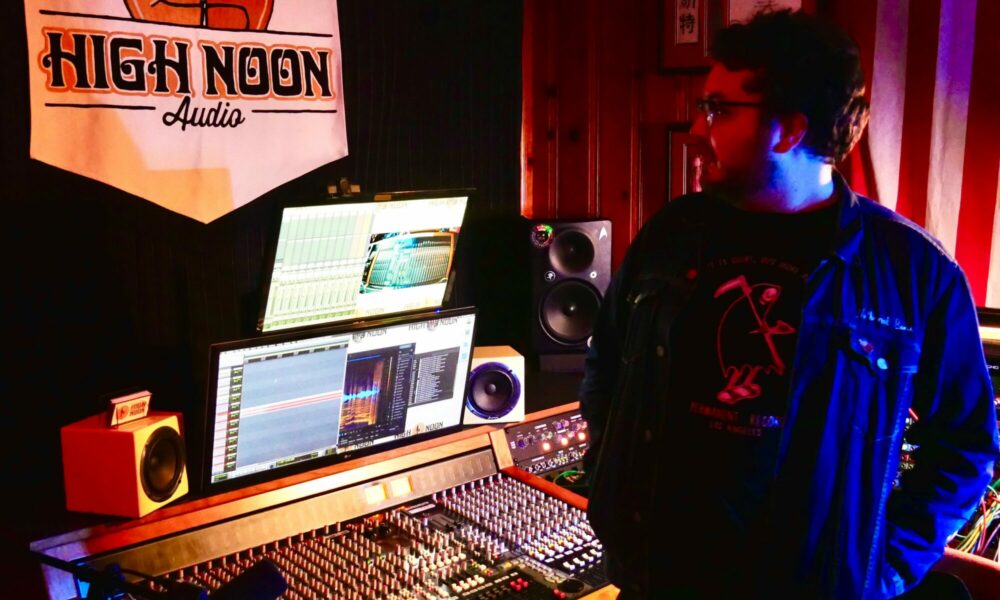
After a quick stint at United Record Pressing working in their offices – I was furloughed due to the pandemic. This period was a wake-up call for me to be sure to establish my “side business” as a recording engineer into a full-time one. I then created High Noon Audio, my recording studio business and primary source of income. I pulled all the money I could out of my savings and invested all of it into building my dream studio. Soon I had a recording console, a tape machine, microphones, a computer, monitors, outboard recording equipment, and all the necessary accouterments to make this new venture a success. I built High Noon Audio using the knowledge I gathered from all my time at Rockwell, Berklee, and Capitol, and there are bits and pieces of each in the layout. At High Noon Audio, I mix, master, and record music for clients around the world. I do my best each day to help musicians find their musical identity and ways to best communicate the ideas and sounds in their heads. I can honestly say I’ve fulfilled a dream I’ve had since I was a young man, and all the adventures, pain, and persistence were not in vain. I’m finally planting roots here in Nashville, which has become my new home. I love this city and all its afforded me to do with my career, and I can’t wait to see what new adventures my time here brings.
Would you say it’s been a smooth road, and if not, what are some of the biggest challenges you’ve faced along the way?
It has not been a smooth road at all. There were many obstacles in my way towards getting to where I am – I was rejected by my major of choice twice while in school, going home from Capitol after sixteen-hour shifts, etc. But the hardest thing to deal with is was the voice in my head who was constantly agreeing with the rest of the world, telling me everything I was doing was stupid and pointless. The mental health nightmare I’ve been through the last decade seriously made me question so much about my life at every turn. Only after moving to Nashville did, I find a balance that’s kept me grounded and happy.
Being a musician is expensive, time-consuming, and often frustrating. Every step forward seems to bring steps backward in its wake, and you have to adopt an almost zen mindset to break through these periods of inertia. There are a million ways to have your music heard in 2022, but that brings a million times the competition and an audience jaded and overwhelmed by the abundance. The only way forward is forward, and I’ve found that persistence is the best weapon in my arsenal as a musician and creative person.
Thanks – so what else should our readers know about your work and what you’re currently focused on?
What I do is primarily divided by what I create for myself and what I help others create via Black Market Dub and High Noon Audio, respectively.
As Black-Market Dub, I create high-quality reggae remixes of famous pop songs from the 70s and 80s. I perform, edit, mix and master everything with my musical partner Wise Owl (aka Brandon Niznik) and have created 35 individual EPs that are all found on my Black-Market Dub Bandcamp page. Black Market Dub has also come to YouTube where Brandon and I host a weekly live stream show. The show is called Black Market Live, where we record music from our respective studios, listen to and critique music submitted by our viewers, discuss audio concepts, and interview guests. The channel also features live dub performances of Black-Market songs from my High Noon Audio recording studio.
Through High Noon Audio, I mix, master, and record music for clients I have acquired over the years through my various travels. I pride myself on building a studio that reminds me of all the studios I’ve worked in over the years and offering a premium experience to musicians on a budget. Through High Noon Audio, I have mixed and mastered albums by Dom Whalley, Aaron Burnham, Stacie Burrows, Sam Slick, Kevin Coons, and many others, with many more to come.
Can you talk to us a bit about the role of luck?
I would be the first to admit that I am incredibly fortunate. Many musicians don’t have the luxury of a decent support system, and I’m so glad I don’t have to count myself among them. My parents, brothers, friends, and girlfriend are all massively supportive of everything I do and have never batted an eye during all of the crazy adventures I’ve found myself on. From an early age, my parents were eager to see me excel in music and went above and beyond in helping me through my time in college. My girlfriend Sarie Gessner, aka Jukebox Mama, is an independent clothing designer who creates magnificent hand-crafted western wear in the vein of Manuel and Nudie Cohen. Her dedication to her craft was a major inspiration for me to commit to music full time, and she inspires me daily to put my creativity first. All of my friends are fellow musicians I’ve met throughout my life, and they all inspire (and hire) me day in and day out. I feel like I forged my path and put myself in situations that would help propel me forward, so in a way, it’s hard for me to credit “luck” as to why I’ve gotten to where I am. But do I feel lucky? Yes – every single day.
Pricing:
- Mixing $150
- Mastering $75
- Guitar, Bass, Keys $50
- Black Market Remix $250
Contact Info:
- Email: highnoonaudio@gmail.com
- Website: Highnoonaudio.com
- Instagram: @highnoonaudio instagram.com/blackmarket_dub
- Facebook: Patreon.com/Blackmarketdub
- Twitter: @blackmarket_dub
- Youtube: Youtube.com/Blackmarketdub
- Other: blackmarketdub.bandcamp.com