




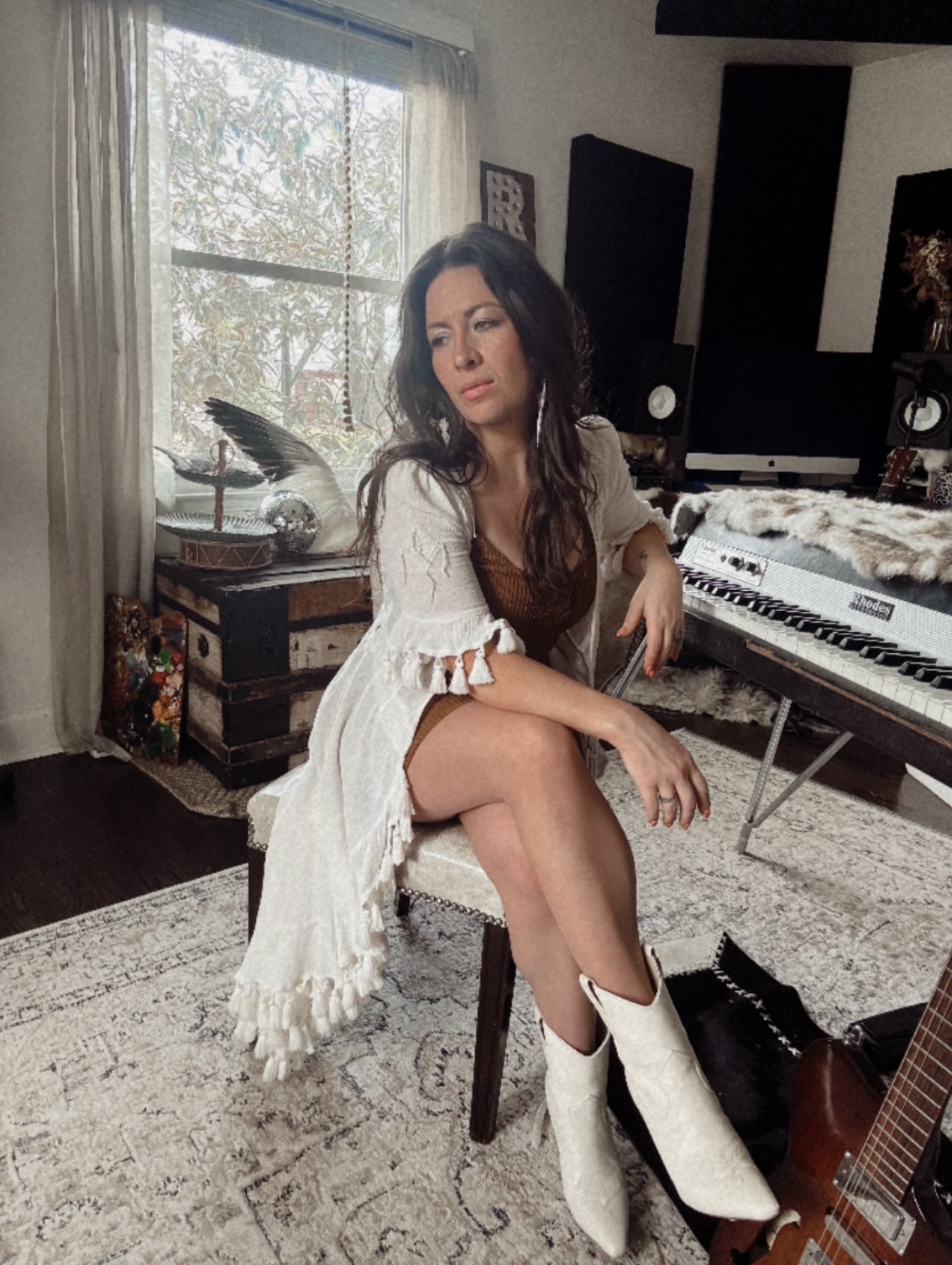
We’re looking forward to introducing you to Kara Hesse. Check out our conversation below.
Good morning Kara, we’re so happy to have you here with us and we’d love to explore your story and how you think about life and legacy and so much more. So let’s start with a question we often ask: What makes you lose track of time—and find yourself again?
There is nothing more cathartic and grounding than exploring your own creativity. The willingness to fall into that unknown and discover something that didn’t exist before is like a drug; the healing kind. Often you learn something from it too; about yourself or the world or a skill you didn’t know you had. And from taking that leap, you’ve grown. There’s magic in that.
……..
What do you think is misunderstood about the music business?
Mmm, a few things come to mind. You know the saying ‘cream rises to the top’? I’d like to believe that, but I’m not sure I do anymore. 120,000 songs are released every day and there are gifted writers and hit songs coming out all the time, but you’ll never know it. For every song that hits the charts, there’s a hundred more gems that will never see the light of day. So much more is required. Budget, branding, storytelling, relationships, timing, consistency. Talent and a good song is really just a small part of success.
Which brings me to another topic that is often misunderstood. Success. One’s version of success can look completely different to another in this business. I’ve always loved that lyric in Counting Crows “Mr. Jones”… “we all wanna be big, big stars but we got different reasons for that.’ That line has a way of reminding me that success is not a one size fits all and how it looks can change with time. Not everyone wants the glitter. Some just want to sustain a life doing what they love or be able to look out at a crowd and see someone singing along. I imagined a lot more glitter in my future early on; a kind of attention that has lost its luster. Success to me is finally putting a bow on that one song or getting a band to commit to a show or waking up to an email that your song has made it to the ‘waiting zone’ of a potential sync deal. I do love me some glitter though.
I used to think getting “signed” was the pinnacle -the ultimate box to check- but it is not the finish line. I hear these stories around town about artists who squander their deal because they think the work is done, but it is really just the beginning. Getting a deal can certainly ease the load but it can also come with a price. There are so many artists out there doing well independently. You just have to work triple as hard and at times it feels impossible with all the hats you have to wear, but if you understand the business, the business protects your art. The ideal would be a partnership.. One that sees you, works alongside you to package your essence. The value of getting signed to a deal varies. It can drastically help or drastically kill, but it does not roll out the red carpet.
Streaming numbers does not equal sustainable income. More and more, artists are vocalizing their discontent with the payouts of streaming platforms, like Spotify, and removing their catalogs from these platforms altogether. Of course while I wish it paid more than .005 cents a stream, I never really weighed it in as a money maker. Even with a million streams, it’s barely enough to cover a month’s rent, but I have always viewed streaming platforms as vessels for exposure. Real money often comes from live shows, sync licensing, merch, alternate businesses like my Roadworn line, and a few sugar daddies. Just kidding, not really.
There’s some truth to the phrase “10 years to Overnight success”. It’s endearing to see someone take it literally, as if year 10 is their year, but I’ve been in this business long enough to know that the longer you stick with it, the higher your chances. What looks sudden and effortless is usually the result of years of invisible groundwork. I like to look at it as a house, and every piece of art or investment you make in your career is one more brick in the wall.
Can you briefly introduce yourself and share what makes you or your brand unique?
I am a singer-songwriter, producer, filmmaker and designer of a handmade wearable line I call Roadworn Handmade that was born out of boredom on long stints out on the road. I was born into a musical family and found songwriting at a young age as a way to understand and cope with what was going on around me. Making a career in music was an easily supported thing and I just sort of fell into it naturally. I have spent the last two decades moving around the country, touring and self-releasing records and have been living in Nashville for a few years now. Excited to announce my latest LP, Devil & the Dove, will be released into the wild this February 27th, 2026.
Amazing, so let’s take a moment to go back in time. What’s a moment that really shaped how you see the world?
I grew up in Wichita, Kansas for the first decade of my life. I lived next door to a nunnery and attended a private Catholic School on the other side of it. Organized religion around the world was a nonexistent concept in those classrooms. There was only one true religion, Catholicism and that was all I knew, besides the Protestant church across the way that always seemed more lax. When I was 11, we moved to Boulder, Colorado, where my dad got a new job and I went to a public school for the first time. No more plaid jumpers. 8th grade was the year the doors of my mind would get completely blown open. The world was no longer black and white and there was suddenly so much more to discover. I found myself fixated on wanting to understand human behavior and why the need for organized religion and how it differed around the world. I think that’s a big part of why I was drawn to music so much. It just seemed to be a language I could always connect easily with and with others. It made the most sense and felt the most genuine.
Was there ever a time you almost gave up?
Oh, yesterday and the day before and the day before that. Kidding, not really.
Realistically, I’ve been in burnout for years now but I’ve learned to cope with it. I think I’ve had to develop a daily practice of reflection, recalibration, and learning to lower expectations to consciously let the present flow as it did when I first fell in love with it all. Burnout doesn’t come from what most people think it does, however. My first gig was 20 some years ago. Since that time, I’ve had to learn how to wear a lot of different hats and wear them simultaneously. Essentially I had to teach my dominantly creative left brain how to communicate with my right, training myself to slow down enough to juggle things like logistics, running ads, building feasible tours and creating press releases. Basically I had to learn how to run a small business, investing and employing staff, learning how to brand, market etc., and be comfortable with rolling the dice with my piggy bank every day. Music is a tightrope walk of managing relationships, logistics and keeping your shit together, all the while staying creative when your cup is empty, and looking cute all at the same time. I think managing humans has been the hardest part for me. I’ve had enough conflict in my life.. I tend to veer away from it. I’ve noticed as a woman, I have to work twice as hard to gain respect and be treated in the way I feel we all should be, even as I’m writing the paycheck. It can be really exhausting, but I wouldn’t trade it for anything. I think life would be pretty empty if I did anything else.
So a lot of these questions go deep, but if you are open to it, we’ve got a few more questions that we’d love to get your take on. What are the biggest lies your industry tells itself?
Oh this’ll be fun. I’ll lay this out as a bulletlist…
– Pick a lane: so false. The greatest breakthrough artists usually hang on the fringes of more than one genre. Sound stands out when it’s not in a box. I think it’s okay to be a little all over the place -just enough to feel fresh, having one thing as the common thread, like a voice or a vibe. Music is trial and error just like discovering medicine. We won’t know it’ll work until it does. It makes sense why the industry would be afraid of that as there’s no guarantee of a return. But that’s the fun in it. The industry may not get it yet, but you’re better off being yourself and letting an audience find you than try to manufacture a sound that the world has already heard before. These days, the industry often follows artists whose audience has already found them anyway.
– You have to write with multiple people to have a hit. I get it.. More hands on deck, more mass potential, but too many chefs in the kitchen can dilute the purity of a song. Collaboration is awesome, but not a must. This became an apparent perspective when I moved to this city. It’s like they wouldn’t even accept a song unless it had multiple writers on it. There are plenty of hits that have been solo writes. Don’t listen to the rules. Many of them are illusions.
– You can’t be a songwriter, an artist AND a producer all at the same time. This is a mindboggling perspective I’ve noticed some to have deep in the songwriting community of Nashville. I’ve been all of those things my entire career and it’s served me well and I intend to keep growing in all of them and more. I’m not sure why there is this mandate to have one focus, but I do know if you can do all this in say, New York, LA or Austin, you’re a triple threat. Not to mention, it makes things cheaper!
– You have to be young to be relevant. I’m still listening to music that came before I was born, just as the younger generations still buy the dang vintage Lynyrd Skynyrd T for eighty bucks. People of all generations are still drawn to music that feels lived. If we’re measuring sound by age, then we’re not really listening. No one can fight time, but no one should dim their light because the clock is running.
– Viral equals valuable: I’m learning to not look at those numbers anymore, even if the industry does. It’s a distracting system; a silent killer and it’s not always honest. We are a culture that listens with our eyes. I think it’s very dangerous to gauge our worth this way. I’ve seen artists lose themselves because they’re only seeing their worth as a scale or measurement and then it stifles their forward momentum. It’s challenging at times when it feels like the only way to get more work, but that’s when people start falling into the pits of creating content that ends up appearing more like desperation. Bigger numbers don’t always mean deeper impact. You’re better off with 200 die hard fans that stick with you than 200,000 passive listeners.
Before we go, we’d love to hear your thoughts on some longer-run, legacy type questions. Could you give everything your best, even if no one ever praised you for it?
My relationship to my endeavors have always begun from a sacred, personal space that doesn’t invite praise in right away, so I’m already giving it my best before I expose it to that potential. Last year, I became aware that I may be more relentless with my ideas than I realized, so much that it can drive people crazy. I’ve learned to accept that part of me and see it as a strength. I do think artists naturally feed off of connection with others through their art, but fall in love with the process and praise just becomes a perk. Giving my all to my art is like breathing. The applause is always a nice follow up, but it’s not going to keep me from taking another breath.
Contact Info:
- Website: https://www.KaraHesse.com
- Instagram: https://www.instagram.com/karahesse/
- Linkedin: https://www.linkedin.com/in/kara-hesse-22a498a8
- Facebook: https://www.facebook.com/p/Kara-Hesse-100063163451904/
- Youtube: https://www.youtube.com/@KaraHesseOfficial
- Other: https://karahesse.komi.io/www.RoadwornHandmade.com