



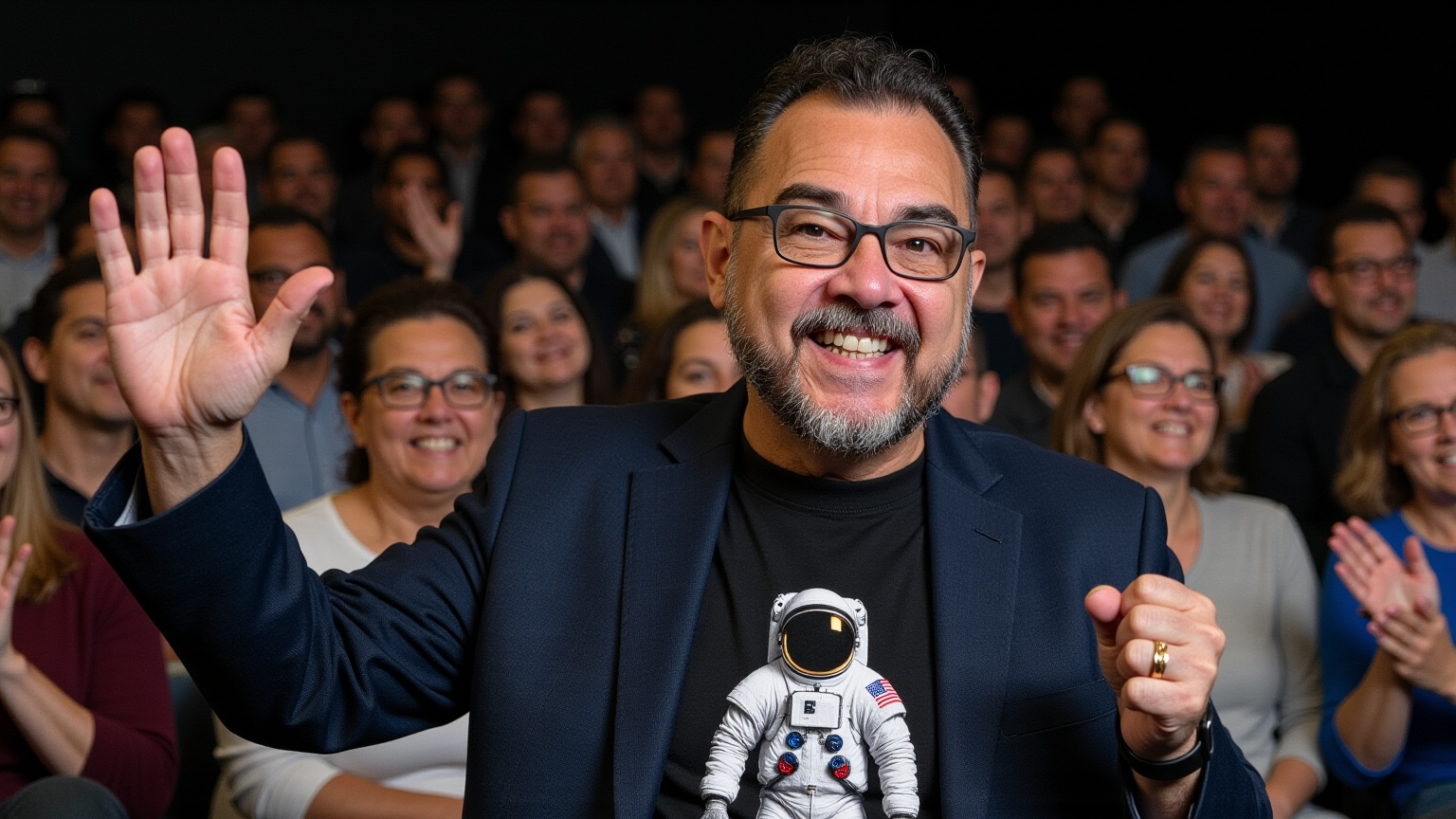
We recently had the chance to connect with JC Quintana and have shared our conversation below.
JC, so good to connect and we’re excited to share your story and insights with our audience. There’s a ton to learn from your story, but let’s start with a warm up before we get into the heart of the interview. What makes you lose track of time—and find yourself again?
I wrote my first poem when I was 17. Not long ago, I found an old box filled with dozens of those early pieces, and it felt like opening a time capsule. I’ve been slowly going through them, translating a few into English, rewriting others, and even turning some into song lyrics. It has been surprisingly energizing. There is something powerful about rediscovering words pulled from the deepest corners of your own life, the joy, the hurt, and all the messy and beautiful things that come from really living. It reminded me why I started writing in the first place.
Can you briefly introduce yourself and share what makes you or your brand unique?
Sure. I’m JC Quintana, and my work centers on helping people and organizations have better EXPECTATION conversations. I started my career in the U.S. Air Force, which instilled in me a deep respect for learning, discipline, and service. Over the years, I moved into roles where I led customer experience, relationship management, and human-centered design efforts for global organizations, eventually becoming an author, workshop facilitator, and consultant.
After selling my last company, I realized that so many business challenges come down to one thing: people struggling to discover, align, and negotiate expectations. That realization shaped everything I do today. My books and workshops explore the psychology behind these conversations and offer a practical framework based on seven core expectations that influence every stakeholder relationship.
We rebranded last year to jcquintana.com to reflect that personal focus, since the work is rooted in my own story and decades of research and experience. It has been exciting to see how the framework applies not only to people and processes, but also to technology, especially as organizations make sense of artificial intelligence. Watching it help both business and personal relationships grow has been incredibly rewarding. It has also helped us expand our focus to assist individuals in growing beyond the workplace.
That is the heart of what I do and why I do it.
Thanks for sharing that. Would love to go back in time and hear about how your past might have impacted who you are today. What breaks the bonds between people—and what restores them?
That is such a great question, because it gets right to the heart of why relationships succeed or fall apart. I think a lot of the strain we see between people comes from the expectations we carry into our interactions. We show up with ideas shaped by our past, our needs, and our assumptions, and those ideas do not always match the reality of the workplace or the relationship in front of us.
Some people come to work hoping for mentorship or emotional connection from leaders who may not be prepared to offer that. Others look for acceptance or friendship in environments that are mostly transactional. Customers and partners do the same thing when they bring us needs or hopes we are not equipped to meet. Whenever expectations are misaligned, the bond between people begins to fracture.
The good news is that alignment can restore almost anything. When we take the time to clarify what we expect from each other, the relationship either strengthens or becomes better defined. Even naming the type of social exchange we are in brings a level of honesty that helps everyone move forward.
I have seen this play out repeatedly. I have worked with teams and executives in situations where the relationship between a company and a customer, or an employee and an employer, or even a partner and a vendor seemed beyond repair. But once we slowed down, uncovered the expectations that had gone off-course, and talked openly about mutual value and fairness, things shifted. In many cases, the bond was restored. In others, it transformed into something healthier and more realistic.
I genuinely believe that with the right framework, the right mindset, and the willingness to talk openly about expectations, even the most damaged relationships have a path back to trust.
When did you stop hiding your pain and start using it as power?
A little over five years ago, everything in my life slowed down, whether I wanted it to or not. My father had a stroke that left him paralyzed, and it happened just weeks after he buried his wife. While he was still in the hospital in San Juan, Hurricane Maria hit and devastated the island. I managed to get on one of the first flights after the runway reopened, brought him home, and became his full-time caregiver for nearly six months.
The complicated part is that my father and I never had a good relationship. He left us when we were young, and much of that pain sat unresolved for decades. During those months caring for him, I learned pieces of his story I had never heard. I discovered that the abandonment I felt as a child had come from his own deep wounds. He had spent a lifetime hiding a sense of worthlessness and inadequacy, and seeing that up close changed something in me. I saw myself in him for the first time.
That experience forced me to stop hiding my own pain. I had been using it as fuel to succeed, to create, to push harder and harder without ever acknowledging what was underneath. Two months after I transitioned my father to my sister’s care, I had a stroke of my own. It should have killed me. Instead, it became a reset. It stripped away the illusion that strength comes from silence and reminded me how much power there is in vulnerability.
Today, I try to live with more openness about the pain we all carry. That honesty has made me more positive, more generous, more grateful, and genuinely kinder. It taught me that our pain is not something to hide. It is something we can transform into clarity, compassion, and purpose.
So a lot of these questions go deep, but if you are open to it, we’ve got a few more questions that we’d love to get your take on. Is the public version of you the real you?
It wasn’t always true, but today the public version of me is absolutely the real me. What you see is what’s inside. I remember a moment that really shifted things for me. I was speaking at an event in Memphis and sat down with the organizer to ask for advice. I had just started my second company and, like many new founders, I was struggling. I asked him what I should do differently. He didn’t even blink. He said, “JC, you just keep being JC.”
It took years for me to understand what he meant. He wasn’t giving me a business strategy. He was telling me to stay rooted in who I naturally am, not in whatever role I happen to hold. My closest friends have echoed that same message in their own way. They’ve reminded me that the things people respond to most—my positivity even in chaos, my generosity even when I’m stretched thin, my gratitude for what I have, and my insistence on choosing kindness, especially toward myself—aren’t traits I picked up for work. They’re simply who I am.
There’s another story that crystallized this for me. When I was 21 and in the Air Force, I was sitting in a flight line cafeteria in the Philippines when two Marine Corps Harrier pilots walked in without name patches on their uniforms. I asked why. One of them looked straight at me and said, “Because we know who the @!#% we are.” It was blunt, but it stuck. To me, that’s the whole game. Know who you are… keep making that person better… Everywhere.
In recent years, leaning into that authenticity has made me even more of a storyteller. It’s pushed me to create a children’s book series about navigating the hard things in life: the body we live in, the pull of prejudice, and the danger of unchecked anger. It’s the most honest creative work I’ve ever done, because it’s coming from the real me—the same person you’d meet on stage, in a workshop, or sitting quietly at home reflecting on life.
So yes, today the public version of me is the real one. And it feels really good to live that way.
Okay, we’ve made it essentially to the end. One last question before you go. If you knew you had 10 years left, what would you stop doing immediately?
It’s funny because that question doesn’t feel hypothetical anymore. I turn 62 next year, and even though I’m in great physical shape, I’m more aware than ever that life has some unavoidable limits. At 17, I thought I was bulletproof and destined to live forever. Now I’m in a stage where the things that genuinely matter look very different.
I’ve always been committed to self-improvement, and I’ve spent years trying to become a more thoughtful, conscientious human being. My mantra has been the same for a long time: be positive, be generous, be grateful, and be kind. The generosity and gratitude come naturally. The kindness, too. But the “be positive” part can get tricky.
We live in an era where negativity is a constant soundtrack. Social media is always trying to lure us into outrage, judgment, or fear, often about things we barely understand. Choosing not to listen requires real effort. If I only had ten years left, the very first thing I would stop doing is feeding negative thoughts. And to be honest, that is something I work on every day already.
I recently read an article that said avoiding negativity has a greater psychological impact than simply trying to be positive. It suggested that the real power comes not from forcing positivity, but from refusing to give your energy to negative attitudes and reactions. That resonated with me. If my time were truly limited (and it is), I would guard my mind fiercely. I would stop letting negativity rent space in my head and focus on the things that add meaning instead.
That is what I would quit immediately. And maybe it is what I’m already trying to quit now.
Contact Info:
- Website: https://www.jcquintana.com/
- Instagram: https://www.instagram.com/j.c.quintana/
- Linkedin: https://www.linkedin.com/in/jcquintana/
- Youtube: https://www.youtube.com/@jcquintana
- Soundcloud: https://soundcloud.com/you/albums