





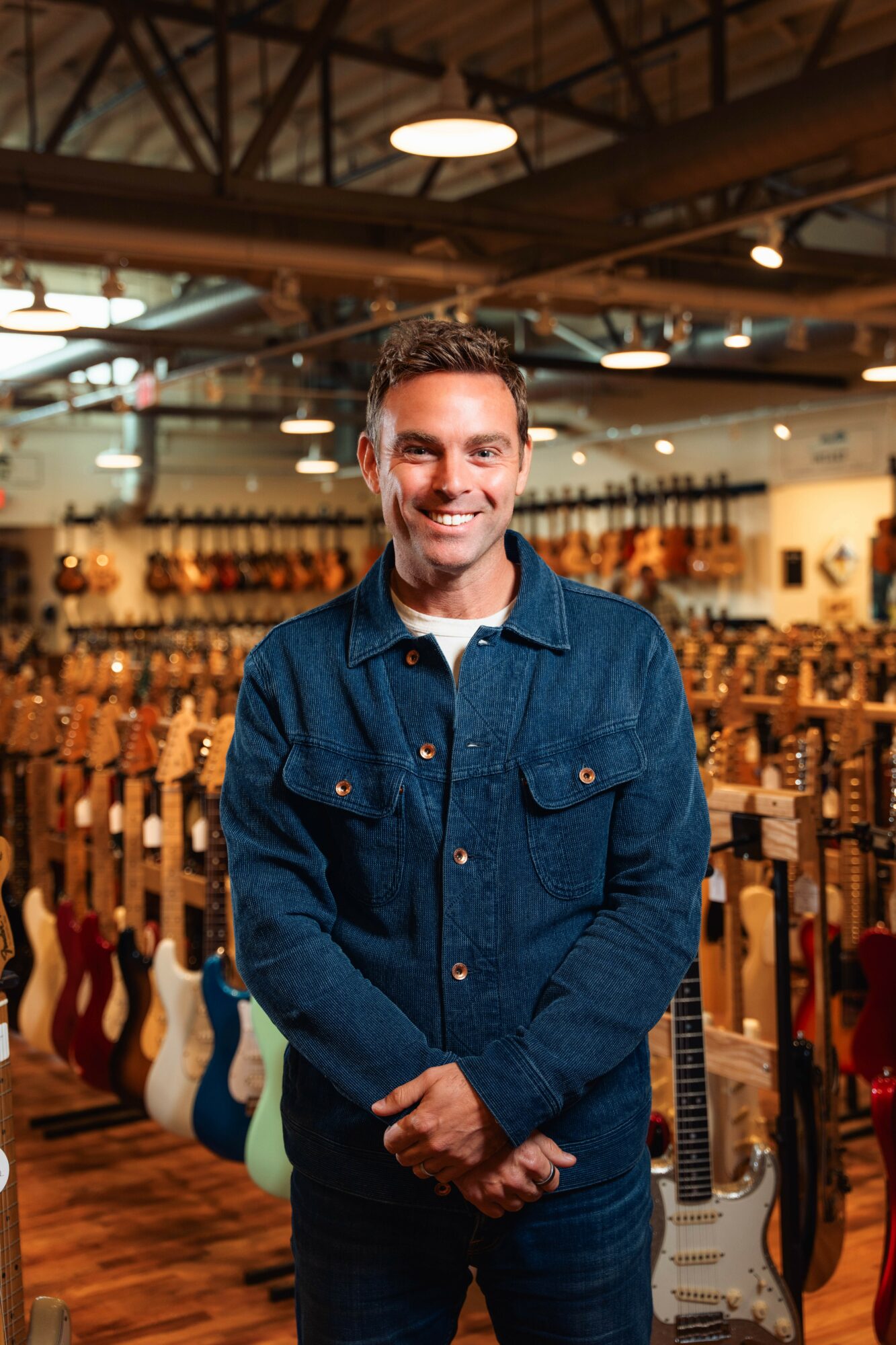
Today we’d like to introduce you to Ben Montague.
Hi Ben, we’d love for you to start by introducing yourself.
Music came first. My father played in bands when I was a kid, so there was always a guitar in the house. We’ve always loved music as a family, and I grew up on the very best of it: The Who, Eric Clapton, the Rolling Stones, the Beatles. At 16, I started my own band, and from that point on, it was my whole life. I knew I wanted to be a musician.
At 24, I started an events company, so I could be my own boss and chase music on my own terms. In 2007, someone at Kobalt Music Group heard one of my songs, and I was flown to Nashville to work with producers. I came back to Nashville to write my first album, which became BBC Radio 2’s Record of the Week, and I went on to tour, supporting Joe Bonamassa and Simply Red.
Throughout that part of my career, I was buying and selling guitars on the side. In 2010, my father and I started The North American Guitar in London as a hobby. In 2012, I left my record label and started putting real hours into the shop, though I still played anywhere that would have me: airports, house parties, anywhere.
The moment I knew the business could be something was in 2015. I watched a Volkswagen salesman do a video walkthrough of a car and thought, why can’t I do that with guitars? So, I’d cycle into the London shop at 6 a.m., set up a tripod and play guitars to share with customers in America before they went to bed. That’s how we built trust with people who’d never set foot in the shop.
In 2019, an opportunity came up in Nashville. I partnered with Kim Sherman to bring Cotten Music Center into the family with no outside investors, and TNAG had its first home in the US. After moving to America full-time in 2021, I sat down with Walter and Christie Carter and presented a plan to carry their legacy forward. We closed on Carter Vintage Guitars in February 2022.
Then, in 2025, Norman’s Rare Guitars released its documentary. I called Norm to congratulate him, and he told me he was thinking about what came next for the store. Not long after, Norman’s became part of the family, too.
Today, TNAG Global is still family-owned, has 55 team members across Nashville and LA, and has more than 4,000 guitars between our two stores.
Alright, so let’s dig a little deeper into the story – has it been an easy path overall and if not, what were the challenges you’ve had to overcome?
No, and I’d be suspicious of anyone who says theirs was.
The hardest decision I ever made was choosing between music and the business. For years, I tried to do both, and eventually I had to be honest with myself that I couldn’t give either one everything it deserved. Walking away from music was painful. It was also the right call, and I still get to spend every day around the instruments and the people who play them.
Moving the business and the family to America was a real leap. My wife and I carried a lot of uncertainty through those years, and after Carter’s, there were plenty of moments when we didn’t know if it would all hold together. We kept our heads down, worked hard and backed each other.
The biggest challenge, and the one I take most seriously, is trust. These stores have communities of players and collectors who’ve loved them for decades. When a new owner walks in, people worry that the soul of the place is about to disappear. We had to earn the right to be there, and we still earn it every day. Some days when the cameras are off, I’ll walk into that store, and I’ll actually kiss the floor. That’s how much it means to me to be trusted with it.
As you know, we’re big fans of TNAG Global. For our readers who might not be as familiar what can you tell them about the brand?
TNAG Global began in London in 2010 as a hobby between my father and me. We simply loved guitars, especially luthier-built and vintage instruments. By 2012, the hobby was getting expensive, and we very nearly closed it down. That was the moment I leaned on everything I’d learned as an independent musician and from my days at my events company and started building the company properly: the brand, the content and our online reach. The focus was always the same. Introduce this little guitar shop and the content we were making to the world, take care of our customers, and they’ll keep coming back.
We worked with private equity for a short period while we were raising capital to expand. After two years, it was clear the fit wasn’t right, and I bought the company back. Today, we’re still family-owned, and Nashville is now home.
What we do is simple to say and hard to do well. At heart, we’re a brick-and-mortar marketplace that runs consignment at scale, connecting players and collectors who want to sell with buyers around the world. We’ve grown from consigning around 50 guitars a month to around 700. We’ve done that with fully proprietary technology we’ve invested heavily in, plus good old-fashioned hard work and customer obsession. Today, we look after some of the world’s most iconic independent guitar shops, so they last for another generation: Cotten Music Center and Carter Vintage Guitars here in Nashville, and Norman’s Rare Guitars in Los Angeles.
I think of myself as a custodian, not a conqueror. Richard Cotten, Walter and Christie Carter, and Norman Harris built these businesses long before I arrived. My job isn’t to put a corporate badge on them. It’s to protect what makes them special and give the teams the tools to reach more people than ever.
What sets us apart is our team. Authenticators, luthiers, repair techs and salespeople who are among the best in the world at what they do. Inside the building, I talk about us as a linked chain: every department wrapped tightly around the next, from intake to repair to the floor to shipping.
Also, the experience of being in our shop. Between eight and nine thousand people walk through our Nashville doors every month, from first-time visitors to touring artists. Every one of them deserves the same care.
Another way we set ourselves apart is our unique consignment process. Players and collectors trust us with instruments they love. We authenticate them, repair and set them up, photograph them, and put them in front of buyers around the world. The seller agrees on the marketing budget with us, there are no hidden costs, and our goal is to put as much money as possible in the seller’s pocket.
Lastly, we’re more than a store. Carter Vintage has its own event space, the Vault, where we bring the community together around the music.
What I’m proudest of is that these still feel like the shops people fell in love with. If Walter or Norm walks in, I want them to recognize it.
What’s next?
a. Our plans are pretty simple: Keep serving our customers to the very best of our ability, whether that’s on the sales floor, in consignment, in merchandising or in repair. We want every customer to know they are seen, respected and cared for every time they walk into the building, whether it’s their first visit or their hundredth.
b. We do that by investing in phenomenal people and always looking for ways technology can help us serve customers better without losing the human side. A recent full company audit led us to add a QR code tagging system to our price tags, so we can understand what people are drawn to and reward them for coming back.
c. We are always looking for opportunities to serve our customers in new and exciting ways, and we’re excited about some great projects on the horizon. And we’ll keep doing what we’ve always done, serving our customers one instrument at a time.
Contact Info:
- Website: https://cartervintage.com/
- Instagram: https://www.instagram.com/cartervintageguitars/
- Facebook: https://www.facebook.com/CarterVintage
- LinkedIn: https://www.linkedin.com/in/ben-montague
- Youtube: https://www.youtube.com/user/cartervintageguitars