

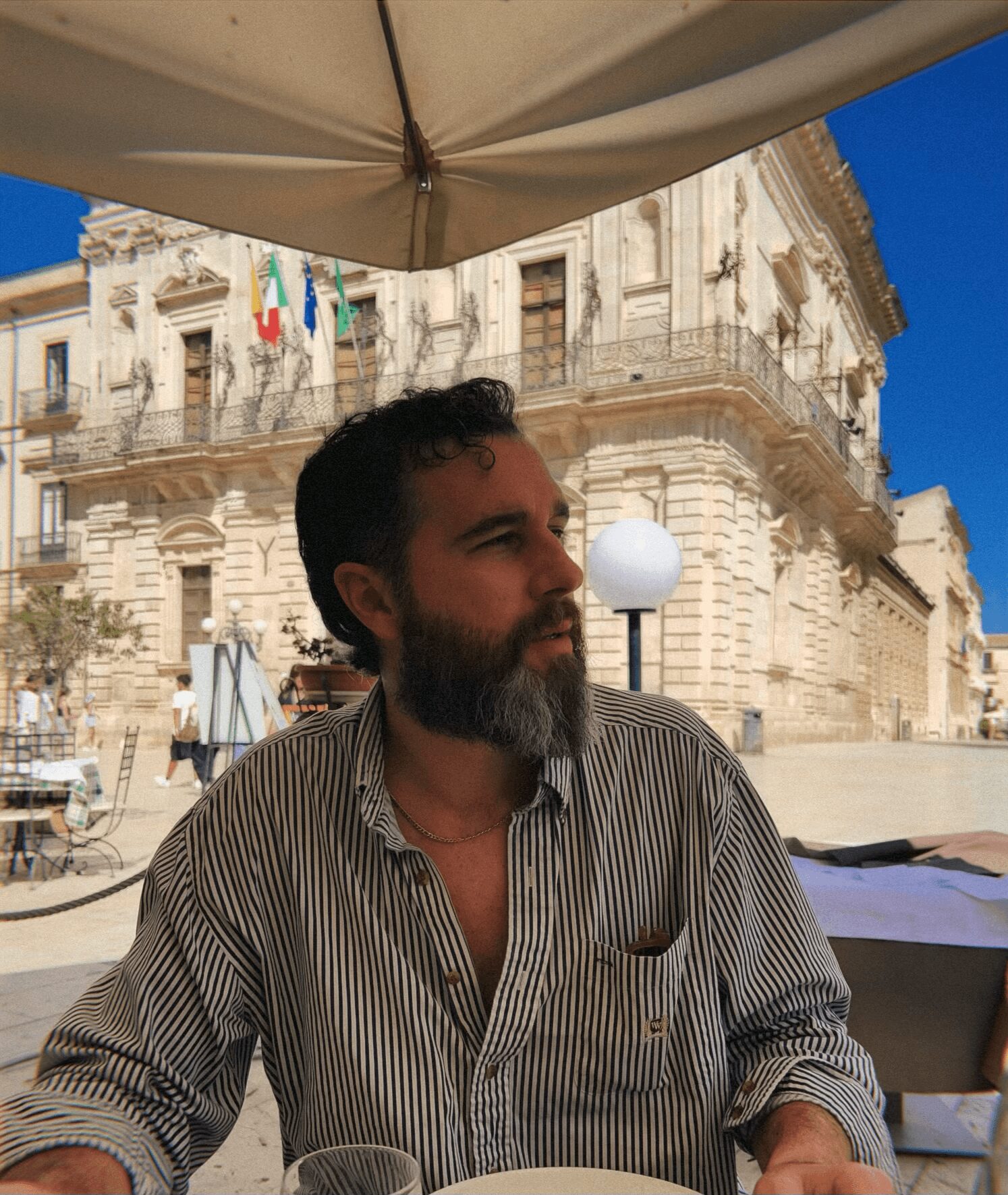
Today we’d like to introduce you to Joel Kaiser.
Hi Joel, so excited to have you on the platform. So before we get into questions about your work-life, maybe you can bring our readers up to speed on your story and how you got to where you are today?
Some guy from the East Coast of a big ole slab of land here. A place that once felt simple and structured, where community thrived among natural beauty, and that now hums with a complex, unfurling super society.
I often say/sing that “we’re all river rats afloat while spinning in unknown space”, but after letting love find me again, I hum it hopefully. Relax. The stream and its celestial eddies, wherever it’s all from, is taking us where we’re going. So I’ll take a pause here, dry off, and really give it my best shot to reach out through these symbols. I genuinely hope something about my own paradigm shifts, and how they prepared me to navigate what may be the most radical paradigm shift in human history, might also help you, stellar reader.
I’m a storyteller at heart. I’ve been singing since I was in a booster seat, hands outstretched wide, singing “I wanna be a sweeeetheart” when Momma asked what I wanted to be when I grew up. By six, my sister Carleigh and I were performing in church and school talent shows, raised in a conservative Christian world that gave us structure, certainty, and clear edges. For a long time, that framework was the lens through which I saw everything.
As I grew up, that certainty began to crack. Through music, friendship, loss, and lived experience, my worldview expanded. Questions replaced answers. Grief replaced simplicity. What once felt fixed became fluid. That unraveling, and eventual rebuilding, became the first major personal paradigm shift of my life. On a less intense note, my oldest sister Genevieve, who wasn’t into conformity, often slipped me ‘secular’ music on burned CDs whenever she got the chance, since I was only allowed to listen to christian music. Thanks, sis. Rock on. Eventually, without even knowing about the MXPX and Linkin Park songs that were now living in my head rent free, my dad even started breaking out the Beatles, Styx, America, and so many more great bands’ and artists’ records. Mom wound up having some favorites from the 70s and 80s in this little musical renaissance period in our home! I couldn’t believe it. Everyone except me and Carleigh had been listening to worldly songs! Gasp.
As I was graduating from Liberty University in Central Virginia years later (which I attended with hopes of becoming a BA Graphic Designer + worship leader), I helped launch Lynchstock Music & Arts Festival in 2013 with close friends, growing it to more than 6,000 tickets by 2018. It began as a benefit concert my good friend Jonny Gregoire wanted to put on as a way to promote his nonprofit, Mustache for Missions. I’d just done branding work for him on M4M and brought the concert concept to my band, Glass Oaks, upon Jonny’s request. It launched off from a backyard on a stage made of wooden pallets. Golden years. Also very dark at times.
After our second year, as the festival was taking off, Jonny passed away suddenly and tragically. Two days before his death, we’d wrapped our first tour and sold out our second EP release show in Lynchburg, celebrating with him during and after the show. The next morning, I discovered I had a vocal polyp. Shortly after, the band dissolved. I couldn’t sing for nine months. The identity I’d built around faith, music, and momentum felt like it was collapsing all at once.
We kept the festival going in Jonny’s memory, even keeping the ridiculous name he stubbornly loved. (Love you, Jonny and I bet you’re laughing about it too, somewhere.) I chose to heal naturally instead of surgery and wrote melodies by whistling them into my phone and shaping songs around them on GarageBand iOS. Those voice memos and rough demos became my EP Call It Pity, recorded in my living room with producer Chris Schlarb just before I moved to Nashville. I released it days before opening for Dawes at Lynchstock’s main stage. Midway through my third song, lightning cracked overhead and a thunderstorm shut the set down. It felt like a warning about ego and control. I didn’t fully listen.
I moved to Nashville on my birthday a few months after that with big dreams and very little restraint. The next few years were messy. Chaotic. I chased image over depth, spiraled through relationships, couch surfed, and at one point lived out of my car while still showing up to rehearsals and recording sessions. Through my project PLSR and a small circle of friends who valued honesty over hype, something started shifting. My faith deconstructed into something less rigid and more compassionate. I began to see that certainty can block curiosity, and curiosity is essential if you’re going to survive massive change.
In 2020, tornadoes ripped through the East Side. Weeks later, the pandemic reshaped everything. While hiding from the twister in a drywall corner of a warehouse with some friends and my acoustic guitar in hand, I remember realizing how unstable parts of my life had become. COVID forced stillness. Through PLSR, we leaned into the idea of being a virtual band, experimenting with animated characters and digital performance. At the same time, between freelance design gigs and creative rabbit trails, I founded SpokeTek and put everything I’d saved into building a real time visual translation dubbing tool for telemedicine after graduating from the Nashville Entrepreneur Center’s PreFlight program.
Just as that venture was taking shape, I met my wife, Brooke. We fell in love in Shelby Bottoms. Falling in love with her grounded me in a hope that didn’t depend on dogma. We eloped in Sicily, traveled to Hawaii for her brother’s wedding, and have been building a life rooted in intention while she navigates chronic health challenges with unbelievable strength. Loving her has reshaped my understanding of faith more than any doctrine ever did.
Eventually, I pivoted SpokeTek into what is now First Rule. I realized that while the technology could be very useful, my deepest calling was still where I’d always been, in the music community. This time, on the tech side. Having already lived through a profound internal paradigm shift, I’m less threatened by technological ones. AI, especially in music, raises real questions about authorship, soul, labor, and truth. I understand the fear. I’ve had to let go of frameworks that once defined me. What I learned is that resisting change outright rarely works. Engaging it with integrity does.
Through our monthly AI in Music Meetup in Nashville and our flagship Music City Make-A-Thon™, we bring artists, technologists, and industry leaders together to build with a humans first mindset. Six days from concept to concert, creatives sprint alongside music tech builders reimagining what’s possible. It’s less about hype and more about stewardship. In every sense, we’ve got to write the future we want to live it.
I still release music with collaborators I love, like Joe Zempel. PLSR is currently working on a double LP paired with a hard sci-fi novel my producer and bandmate Andrew Royal is working on. But the deeper throughline of my story is this: I had to lose certainty to gain adaptability. That adaptability is now the foundation for helping artists and communities navigate one of the largest paradigm shifts of our time, something that I believe can only be done effectively by highlighting our humanity, not replacing it.
Letting my worldview expand prepared me to navigate an era where everything is shifting at once, locally and globally.
So for anyone who feels lost because their plan fell apart or is falling apart presently, I’ve been there and still hit walls that need to be scaled, maybe even knocked over. Sometimes the unraveling is the preparation.
I’m sure it wasn’t obstacle-free, but would you say the journey has been fairly smooth so far?
Not even close to a smooth road.
I’ve experienced public wins and very private losses in the same breath. Our festival I shared about was growing rapidly when my close friend and co-founder of the event passed away unexpectedly. Like I said, two days before his death, I’d finished my first tour with my band. The next morning, I found out I had a vocal polyp. Within two weeks, the band dissolved and I couldn’t sing for the next nine months. Forgot to mention that my idiotic young self thought I could pull all of this off, while graduating college and simultaneously long-distance dating my first actual girlfriend… who lived in Toronto. And she broke up with me over a call and a few texts in those two weeks.. That season forced me to confront who I was without momentum, without certainty, and without the identity I’d built around both faith and music.
To expound a bit on what I shared previously, moving to Nashville brought its own challenges. I arrived with ambition but not much grounding. There were seasons of burnout, unhealthy patterns, couch surfing, and even living out of my car while still trying to show up creatively at shows and recording sessions. Watching peers take off in the world of music while I built their artist/band brands… I felt stalled, and it tested my ego and my sense of purpose. Deconstructing my worldview while trying to build several freelance careers added another layer of internal friction.
Then, like I said… 2020 hit. Tornadoes, a pandemic, and a complete reshuffling of the music ecosystem. Like many artists, I had to pivot quickly, experimenting with virtual performance, animation, and at the intersection of all those things, launching a tech venture that later evolved into my current startup. Betting everything I had on an idea during global uncertainty was both terrifying and clarifying.
Looking back, the struggles weren’t detours. They were refinements. Losing certainty, losing stability, even losing parts of my identity forced me to build adaptability. That resilience now shapes how I approach both music and emerging technology. It’s also why I’m so committed to helping other artists navigate change without losing themselves in the process.
Thanks for sharing that. So, maybe next you can tell us a bit more about your work?
At my core, I build bridges between creativity, community, and infrastructure.
I’m a singer-songwriter and creative director by trade, but today most of my work sits at the intersection of music and emerging technology. I co-founded First Rule, a startup focused on harmonizing AI with the music industry. We create spaces, tools, and events where artists, technologists, and industry professionals can explore AI in a way that protects authorship, prioritizes consent, and keeps humanity at the center.
I specialize in translating between worlds that don’t always speak the same language. Artists are often wary of generative AI music tech. Technologists can underestimate the emotional and cultural weight of music. Because I’ve lived deeply in both creative and startup ecosystems, I’m able to hold nuance in those conversations and design environments where collaboration feels possible instead of adversarial.
Through our monthly AI in Music Meetup and our fast-approaching flagship Music City Make-A-Thon (March 23-28), I’m known for convening serious builders alongside working musicians and industry leaders in a way that feels grounded rather than hype driven. We focus on practical experimentation, ethical frameworks, and long term stewardship over quick wins. Although, the grand prize winning team of the Make-A-Thon might say otherwise, since they’ll have won nearly $7K in prizes in just six days time!
I’m also proud of my work building community at the grassroots level. Helping launch and grow Lynchstock Music & Arts Festival from a local benefit show in 2013 into a multi thousand ticket downtown event by 2018 remains one of the most formative chapters of my life. It proved that culture can be built intentionally when people rally around a shared purpose.
What sets me apart is that I’ve had to personally navigate deep paradigm shifts before asking anyone else to. I’ve rebuilt my creative identity after injury. I’ve deconstructed and reconstructed my worldview. I’ve lived through public success and private collapse. That lived experience makes me less reactive in moments of disruption and more focused on thoughtful integration.
In a time when AI has been utilized in negatively polarizing ways (in paradigm shifting ways, well beyond branding), I’m most proud of creating rooms where people with very different perspectives can sit at the same table and build something better together.
Can you talk to us about how you think about risk?
Risk and I have had a long, complicated relationship.
For a while, I confused risk with recklessness. Moving to Nashville with more pride than a plan. Pouring myself into projects without much margin. Living out of my car while still pretending everything was fine. Betting my entire identity on wisps of momentum. Risks have to be taken to push boundaries, but usually only succeed in doing so when wisdom is part of the equation.
Some risks, though, changed everything.
Choosing to heal my vocal polyp naturally instead of rushing into surgery was a major one. It meant nine months without singing, which for a songwriter feels like losing oxygen. Launching and continuing to grow a music festival after losing one of its co-founders was another. There’s nothing predictable about trying to scale a grassroots cultural event while you and your team are grieving.
Starting a new solo project that tanked my bank account in 2017. Starting a new music project in 2018/2019 with PLSR was another worthwhile risk that carries on… (double album + w/accompanying hard sci-fi novel otw. Release date tbd). In 2020, I put every dollar I’d saved up doing freelance design work into building a real time visual translation dubbing startup in the middle of the pandemic. Later, I pivoted that company into First Rule when I realized my deeper conviction was about the future of music and AI. That shift meant walking away from one vision to pursue another that felt more aligned, but just as uncertain.
On a more personal level, deconstructing my worldview was probably the biggest risk of all. Letting go of certainty. Letting questions breathe. Rebuilding faith in a way that was less rigid and more compassionate, as I said before. That kind of risk doesn’t really show up on a balance sheet, but it reshapes everything.
These days, I don’t see risk as something to chase for adrenaline. I see it as something to steward. The question I ask isn’t “Is this bold enough?” but “Is this aligned?” If the risk expands my capacity for integrity, community, and long term impact, it’s usually worth taking. If it’s just ego or escapism dressed up as bravery, I’ve learned to be more careful. Doing my best to remain optimistic and nurture wisdom in myself.
We’re living in a moment where technology is accelerating faster than culture can process. Working at the intersection of AI and music is inherently risky. But I believe the greater risk is sitting on the sidelines and letting others define the future without artists in the room.
So I take risks now with intention. Less chaos, more conviction.
Pricing:
- $20/team member | Standard Make-A-Thon™ Access Pass
- $35/team member | VIP Innovator Access Pass
Contact Info:
- Website: https://www.firstrule.ai
- Instagram: https://www.instagram.com/firstrule.ai
- Facebook: https://www.facebook.com/firstruleai
- LinkedIn: https://www.linkedin.com/in/joelrkaiser
- Youtube: https://www.youtube.com/@plsr1542
- Other: https://www.firstrule.ai/musicCityMakeAThon